


Coca-Cola and Mengniu are both changing their packaging. In China's $73.6 billion packaging container market, where is all the money going?
The growth of the packaging market is increasingly looking like a 'value competition': by 2025, China's container and packaging market is expected to reach $73.6 billion, but the volume only increases by 1.4%. Most of the new market value comes from higher unit prices. Over the next five years, competition will only get tougher. Those who can control costs while meeting environmental standards will have a better chance of winning orders from big clients like Yili, Mengniu, and Coca-Cola.
This was my immediate thought after reading MarketLine's "China Container and Packaging Industry Report" released this July.
1. Market value is rising, but actual volume hasn't kept up
First, let's look at the scale. China's container and packaging market grew from $58.2 billion in 2020 to $73.6 billion in 2025, with a five-year average annual growth rate of 4.8%. But the growth momentum has clearly slowed down: it was 11.1% in 2021, dropping to only 1.6% in 2025.
Figure 1: China Container and Packaging Market Size, 2020–2025 (Billion USD)
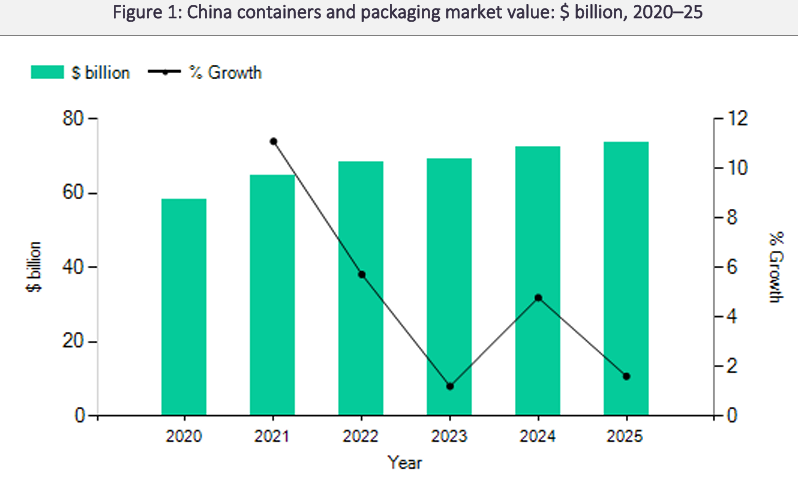
Over five years, the market size increased by more than 15 billion USD, but the growth rate slowed from double digits to around 1%.
The change in volume is even slower. In 2020, the market volume was 50.3 million tons, and by 2025 it had risen to 58 million tons, with a five-year average annual growth of 2.9%, which is lower than the growth rate in monetary terms.
I did a quick calculation with the two sets of numbers, and the average value per ton of packaging is also going up: around $1,157 in 2020 and about $1,269 in 2025; according to the report's forecast, it will approach $1,453 by 2030. In other words, there wasn't much more packaging used, but the unit value increased. The report attributes this change to product upgrades like lightweighting, recyclable materials, and custom designs; this also explains why when I unpack deliveries, I notice more alternatives like paper trays and honeycomb paper, and the packaging boxes are smaller.
There's also a background point worth noting: in 2025, China's CPI increased by 0. So, the rise in packaging prices isn't driven by general inflation but rather by updates and iterations of the packaging products and materials themselves.
Figure 2: China's container and packaging market volume, 2020–2025 (million tons)
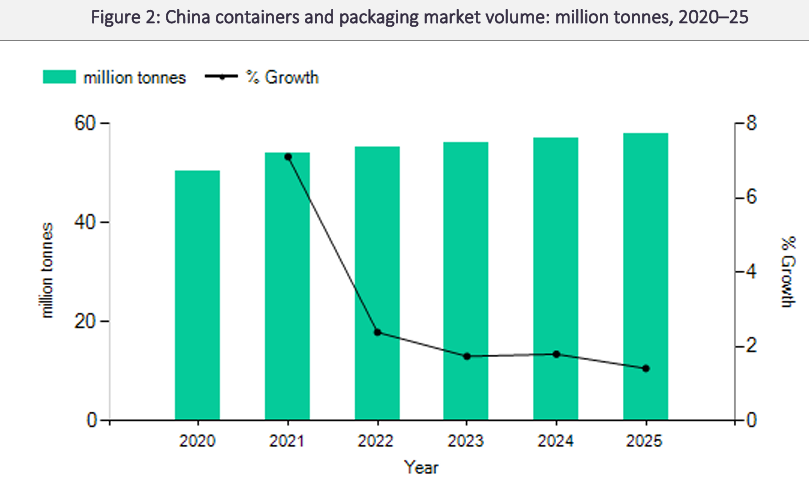
Over five years, usage increased by 7.7 million tons, but the growth rate has been steadily slowing.
2. Over the next five years, annual revenue will grow 3.6%, but usage will only increase 0.8%
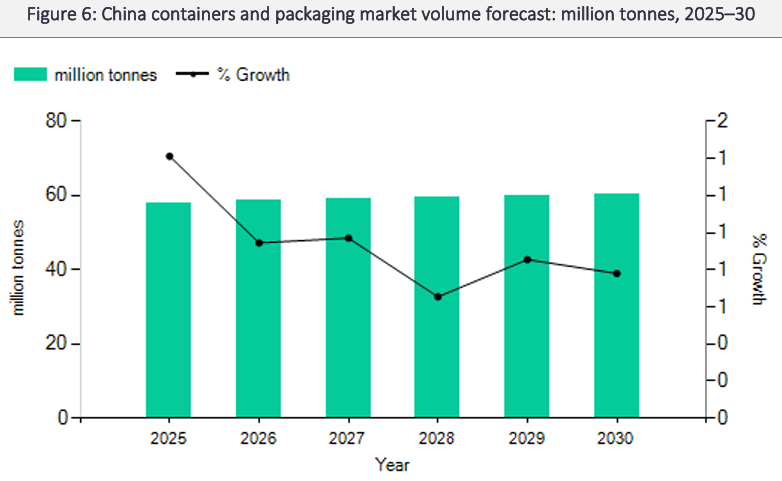
The report predicts that by 2030, the market size of container and packaging in China will reach $87.9 billion, a 19.3% increase from 2025, with an average annual growth rate of 3.6%. During the same period, usage is expected to rise to 60.5 million tons, growing only 0.8% annually, which is close to stable.
What does 0.8% mean? Urban populations are still growing, and online shopping is expanding. According to the report, online retail sales will rise from $819.4 billion to $948.8 billion, yet packaging usage is still unlikely to increase significantly. The reason is simple: everyone is cutting back-boxes are getting smaller, films thinner, and any layer that can be saved is being saved.
Market revenue is expected to grow 3% to 4% per year, while usage growth will be less than 1% annually.
Figure 5: Forecast of China's container and packaging market size, 2025–2030 (billion USD)
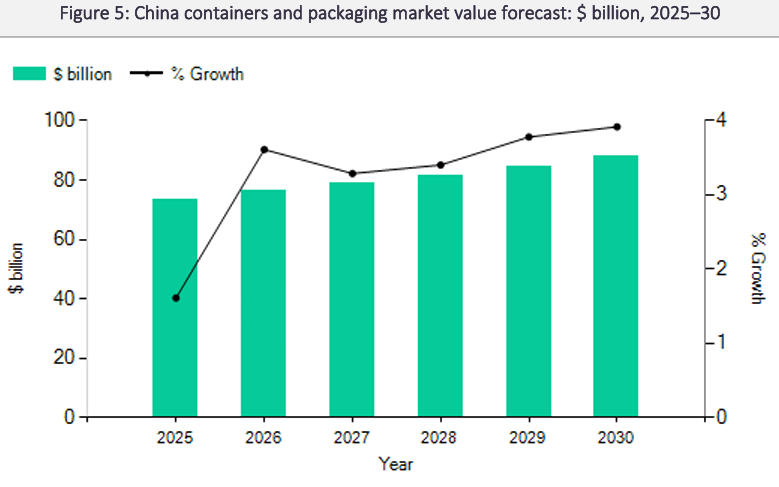
Figure 6: Forecast of China's Container and Packaging Market Consumption, 2025–2030 (Million Tons)
3. Plastic Still Takes the Lead, Paper Growing Fastest
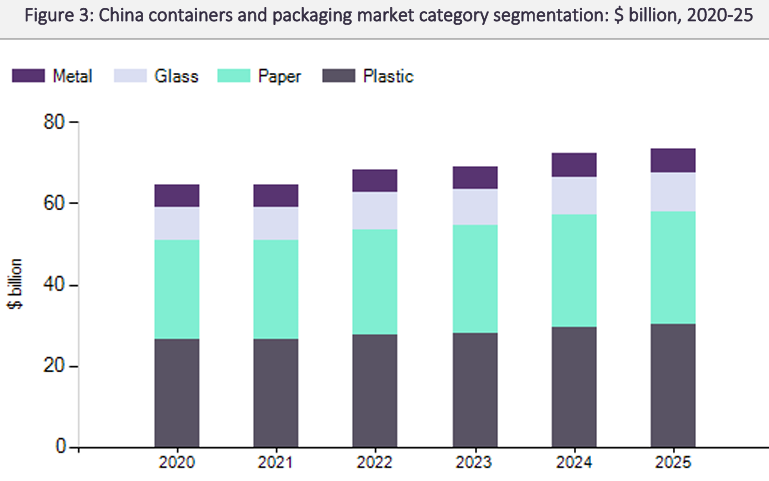
In 2025, the market sizes of the four main packaging materials are expected to be: plastic $30.2 billion, accounting for 41%; paper $27.8 billion, 37.8%; glass $9.6 billion, 13.1%; and metal $6 billion, 8.1%. Over the past five years, paper has had the fastest annual growth rate at 5.2%, while metal the slowest at 3.9%.
However, just because paper is growing fast doesn't mean plastic is losing its foothold. Plastic's market share dropped to 40.5% between 2022 and 2023, then bounced back to 41% in 2025; paper's share peaked in 2023 and slightly declined by 2025. At least according to this data, paper hasn't been steadily squeezing plastic's share.
A friend of mine who works in a dairy company's packaging materials department once shared this analysis: Paper packaging looks nice but is pricier and more sensitive to moisture, so many types of dairy products aren't easy to switch to paper. Plastic is lightweight, unbreakable, and has good barrier properties – the fast-moving consumer goods industry can't do without it, and it'll be hard to shake its top spot anytime soon.
Plastic and paper together make up nearly 80% of the market; paper is growing faster, but it hasn't surpassed plastic yet.
Figure 3: Structure of China's Containers and Packaging Market by Category, 2020–2025 (Billion USD)
4. China Accounts for Over 40% of the Asia-Pacific Market, India is Growing Faster
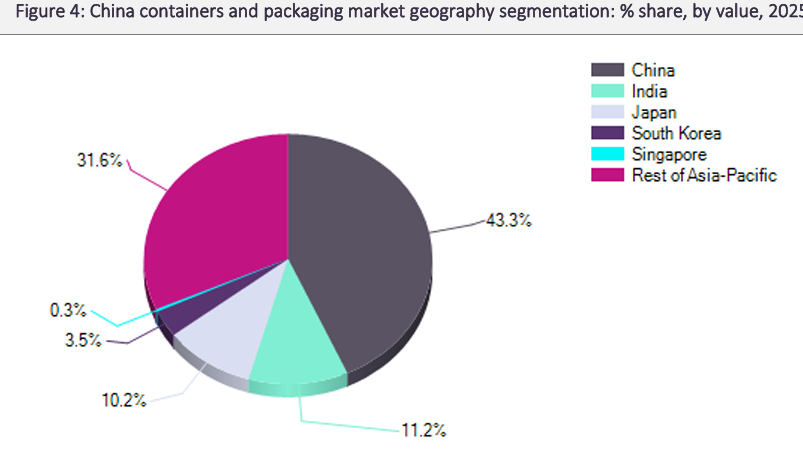
By 2025, the Asia-Pacific container and packaging market is expected to reach $170.2 billion. China will make up 43.3%, India 11.2%, and Japan 10.2%.
It's worth keeping an eye on India, which is projected to grow at an average annual rate of 5.6% over the next five years-much faster than China's 3.6%-and could reach $24.9 billion by 2030. Brands and packaging companies going overseas might want to pay extra attention.
China accounts for over 40% of the Asia-Pacific market, while India's expected growth is even faster.
Figure 4: Market Share of Containers and Packaging in Asia-Pacific by Country/Region, 2025
5. Major companies are large in size, but profitability varies
The report lists representative companies including CIMC, Yutong Technology, Nine Dragons Paper, and COFCO Packaging. However, being big doesn't automatically mean high profits.
CIMC's revenue in 2025 was 156.6 billion yuan, down 11.8% year-on-year, with a net profit margin of just 0.1%. It should be noted that CIMC's main business focuses on containers and logistics equipment, which can't be directly equated with everyday consumer packaging.
Nine Dragons Paper had revenue of 63.2 billion yuan in the 2025 fiscal year, up 6.3% year-on-year, with a net profit margin of 3.4%. But its debt-to-equity ratio rose from 0.74 in 2021 to 1.54, meaning the financial cost of expansion has also increased.
Yutong Technology's profitability stands out more: revenue of 17.2 billion yuan with a net profit margin of 9.2%. It mainly produces premium boxes, color boxes, and labels, serving industries like consumer electronics, tobacco and alcohol, and cosmetics, which are generally more willing to invest in packaging. The closer the packaging is to the brand and consumer, the higher the design content, and usually, the better the profit margin-this is quite noticeable in the industry.
COFCO Packaging is part of COFCO Group, with its core business in metal cans, covering beverage and food cans.
6. Orders are dominated by big clients, leaving packaging companies limited bargaining power
In the report's five forces analysis, buyer bargaining power, supplier bargaining power, and the threat of new entrants are all rated as "medium"; competition within the industry is rated as "strong."
Competition within the industry is the most intense, while the other forces remain at a medium level.
Figure 7: Five Forces Analysis of China's Container and Packaging Market, 2025
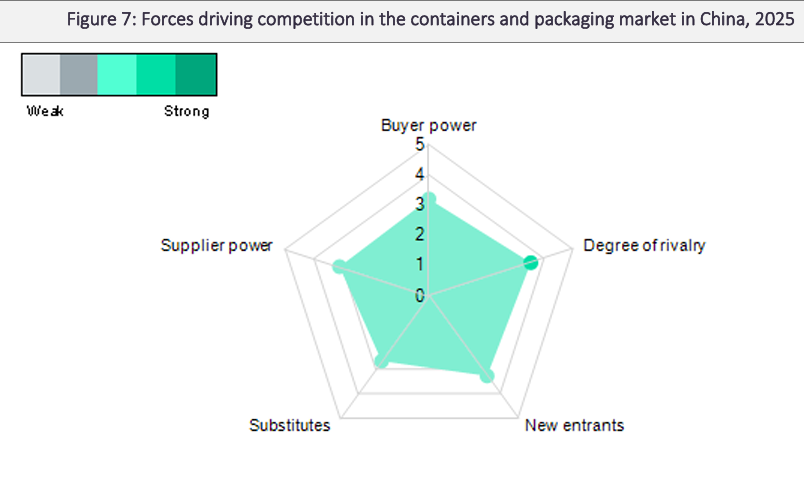
The buyer list includes major clients such as Yili, Mengniu, Alibaba, JD.com, Huawei, Xiaomi, and Sinopharm. They have large purchasing volumes and clear requirements for price, delivery time, and environmental standards; At the same time, the cost of switching suppliers is relatively low. These factors combined mean that packaging factories usually lack negotiation advantages.
However, the report itself also has points readers should pay attention to: the summary rates the threat of substitutes as "low," but the conclusion in the main text says "moderate"; Additionally, there is a section that mistakenly writes "China" as Australia, suggesting the template content is not cleaned up. When citing this report, it is best to check each item carefully.
7. Recent Developments: Paper packaging cooperation, factory expansion, and tightening policies
In July 2026, Smurfit Westrock partnered with Coca-Cola China to launch a paper packaging solution for World Cup marketing, including gift boxes, basket-style retail packaging, and e-commerce shipping boxes. In the same month, Amcor announced the expansion of its Dongguan flexible packaging factory, planning to add 7,000 square meters of factory space and automated warehouses, with the project expected to be completed by July 2027.
Brands are also adjusting their material strategies. The report mentions that Mengniu is already using biodegradable packaging; Unilever plans to reduce virgin plastic usage by 29% by 2025 compared to 2019, with recycled materials accounting for 25%.
Policies have also been tightening: in September 2023, excessive packaging was restricted on food and cosmetics; in April 2024, this was expanded to include fresh agricultural products; and on June 1, 2025, new regulations on express packaging were implemented.
If the brand is planning to change packaging soon, I recommend first breaking down the quote: require suppliers to separately list material and design costs, and confirm whether the eco-friendly materials have food-grade certification. This way, you can figure out where the budget is being spent and reduce compliance risks.
The numbers in this report send a message not that "less packaging means less spending," but rather that the industry is redistributing value: packaging usage is stabilizing, but materials, design, and environmental capabilities are increasingly affecting pricing and profits. How brands and suppliers ultimately share this upgrade cost still depends on the outcome of negotiations within each order.
Three key insights
Insight 1: Volume equals and price rises.
Over the next five years, usage will increase by only 0.8% annually, while value will rise by 3.6%. Packaging per ton is expected to rise from about $1,269 to about $1,453, marking a shift from competing on production capacity to focusing on unit price and added value.
Insight 2: Paper is growing rapidly, but plastics remain stable.
Paper leads with an average annual growth of 5.2% over five years, but plastics' share is expected to return to 41% by 2025. "Paper plastic alternatives" are advancing more slowly in the fast-moving consumer goods category than expected.
Insight 3: Profits concentrate on the design side.
CIMC's net profit margin was 0.1%, Nine Dragons 3.4%, and Yutong, which makes premium packaging, 9.2%. The closer you are to brands and consumers, the more profitable you are.