


China region becomes the cornerstone of resilience, 700 million loss cannot hide its ambition of 'jumping against the wind'!
Amid global macroeconomic fluctuations and slowing consumer market demand, the world's leading system solutions provider, SIG, recently released its 2025 fiscal year report. This report not only documents how the company navigated industry cycles and maintained a solid revenue foundation over the past year, but also reveals a deep internal strategic restructuring.
Through decisive provisioning for non-recurring expenses and iterative management, SIG is attempting to outline a clear future value creation trajectory in a complex and ever-changing global landscape.
Solid Revenue Foundation: Seeking Certainty Amid Uncertainty
Throughout the 2025 fiscal year, SIG demonstrated strong risk resilience. Despite an extremely challenging external environment, the group's annual revenue reached €3.249 billion (approximately RMB 26.1 billion), representing a slight increase of 0.4% at constant exchange rates compared to 2024 (when excluding the impact of exchange rate and resin price fluctuations, revenue was essentially flat year-on-year, growing by 0.1%).
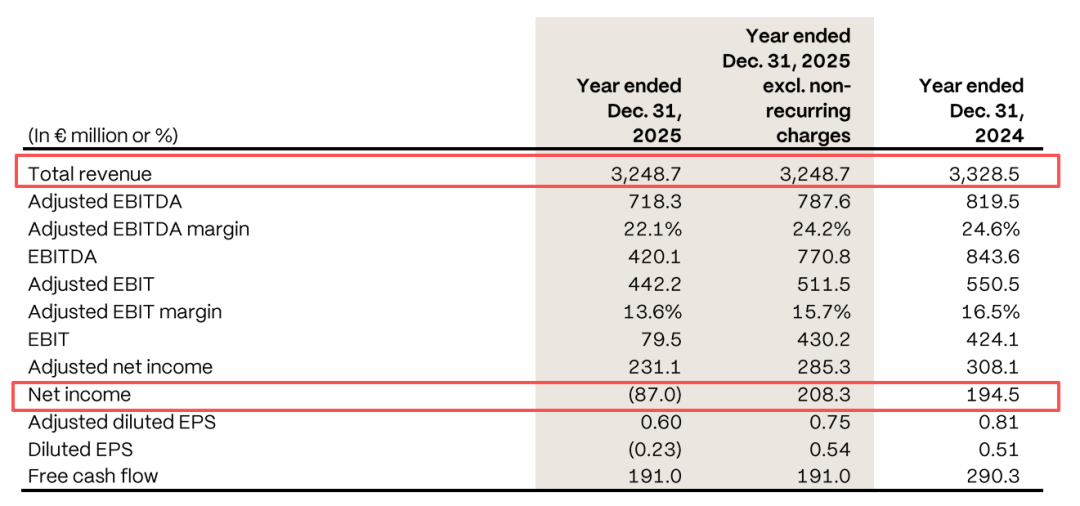
Especially in the fourth quarter, the Group's performance showed signs of recovery, with revenue growing 0.6% at constant exchange rates. Although this figure seems modest, in the context of widespread pressure in the global packaging industry, it is sufficient to demonstrate the resilience of Kangmei Packaging's product portfolio.
This stability is mainly attributed to the company's solid foundation in the aseptic carton market, where revenue grew 1.2% at constant exchange rates. Despite fluctuations in overall sales due to the broader market environment, the company successfully offset the negative impact of declining volumes through flexible annual pricing adjustments and continuous optimization of its product mix.
In other segments, Kangmei Packaging's performance showed structural differences. The chilled carton business declined 5.3% at constant exchange rates in a highly competitive market environment. However, it is encouraging that this segment showed signs of stabilization in the second half of the year, with a notable sequential improvement in revenue.
Furthermore, the bag-in-box and spout pouch businesses faced challenges due to a decline in retail channels, yet they demonstrated strong growth potential in emerging markets such as India.
Financial Performance Analysis: Margin Fluctuations and Strategic "Financial Cleansing"
In fiscal year 2025, Kangmei Packaging made a significant and decisive move on the financial books. The company recognized approximately €351 million (pre-tax) in non-recurring expenses. These expenses are primarily related to current market weakness assessments and the completion of a comprehensive strategic review.
In the short term, this directly reduced the company's adjusted EBITDA for FY2025 from €819.5 million in 2024 to €718.3 million, with an adjusted EBITDA margin of 22.1%.
However, if these non-recurring expenses are excluded, Kangmei Packaging's core profitability remains strong, with a baseline EBITDA margin of 24.2%, only slightly lower than 24.6% in 2024.
A deeper look into factors affecting profit margins shows that the strong appreciation of the euro against the Brazilian real, Mexican peso, US dollar, and Chinese renminbi in 2025 dragged down the margin by about 60 basis points.
Additionally, higher production costs reflected that fixed costs were not fully absorbed due to low plant utilization. On the other hand, declining raw material prices, especially for polymers, coupled with effective internal pricing measures, provided important support for profit margins.
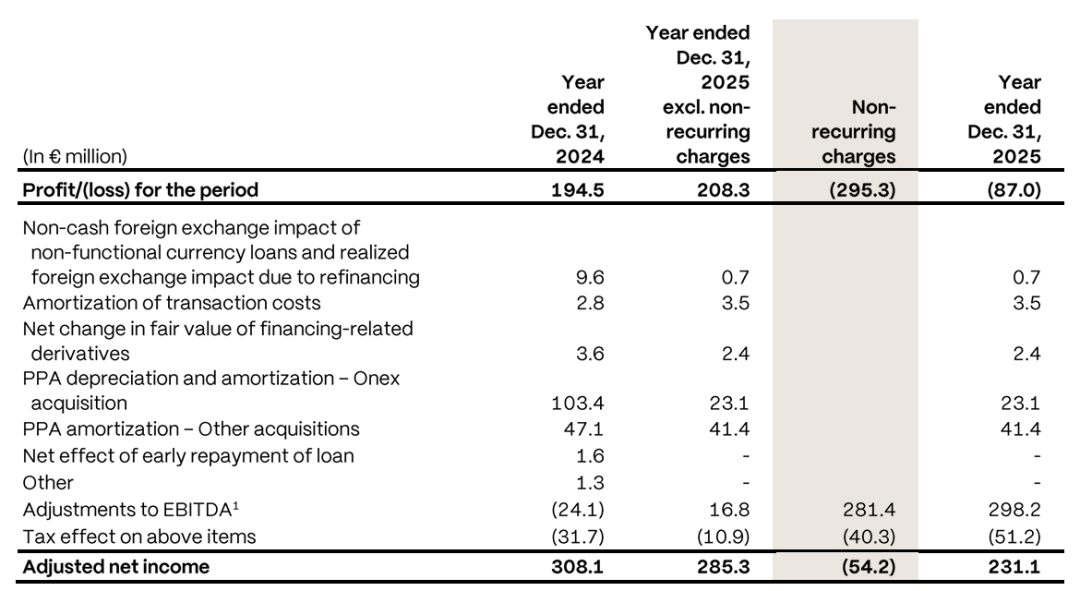
In terms of net profit, the adjusted net profit for fiscal year 2025 was 231.1 million euros. Affected by the large non-recurring expense provisions mentioned above, the book loss for this period was 87 million euros (approximately 700 million RMB).
However, as Chief Financial Officer Anni Eckens emphasized, this is more like a strategic asset write-down to streamline operations. Excluding these disruptive factors, the net profit of 208.3 million euros for this period still reflects the company's solid cash flow generation capability.
Global Regional Scan: Resilience of the Chinese Market and Shifts in the Global Landscape
Kangmei Bao's global business is evenly distributed, but different regions showed distinctly different rhythms in 2025:
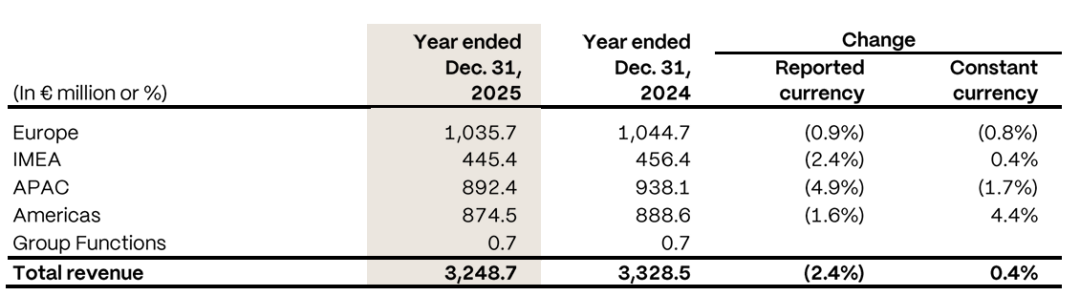
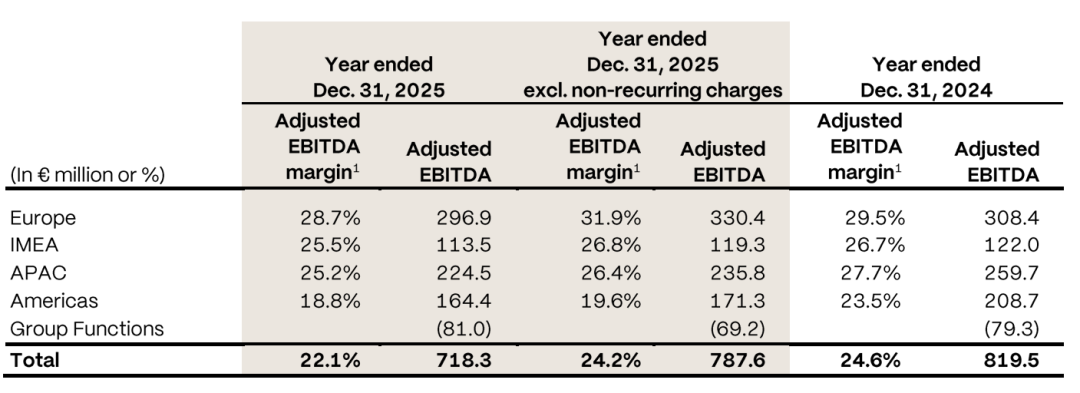
In the Asia-Pacific region, especially the Chinese market, which has attracted much attention, Kangmeibao has experienced a process of "taking off against the wind". In fiscal 2025, the region's revenue declined by 1.7% in constant currency terms. This is mainly due to the postponement of the Chinese New Year in 2026, which has led to the failure of the replenishment peak that usually occurs in the fourth quarter in previous years.
However, the Chinese team has outperformed its peers in an overall downturn through excellent product innovation and high market flexibility. Meanwhile, the Southeast Asian, Japanese, and South Korean markets performed strongly, with growth in filler sales contributing sustained momentum to the region.
Specifically, for the Chinese market, flexibility drives growth against the trend. At present, China's FMCG retail market is undergoing deep structural changes, and the consumption scene is highly fragmented. In the context of continued pressure on core categories, Kangmeibao empowers customers to quickly respond to market fluctuations with a flexible combination of product specifications.
The first is differentiated competition, through in-depth cooperation with dairy companies, the launch of innovative packaging forms, accurately reach consumers' dual needs for "cost-effective" and "novel experience"; The second is the expansion of the track, actively laying out high-growth areas such as 100% non-concentrated reduced juice (NFC) and "granular" drinking desserts, laying a solid foundation for the long-term expansion of the category.
The rest of the Asia-Pacific region is a dual track of health function and sustainability. Despite a decline in dairy and beverage growth in the Asia-Pacific market excluding China due to the slowdown in consumer spending, Kangmeibao has maintained growth resilience through the deployment of new filling equipment. "Health and nourishment" is still the core driving force. In the Japanese and Korean markets, protein and functional beverages continue to be popular, and this trend is accelerating its penetration into Southeast Asia.
In Vietnam, consumers' pursuit of healthy snacks and multi-sensory experiences has directly driven the growth of SIG Drinksplus solutions. At the same time, "jelly drinks" for children and adolescents are becoming a new growth point for liquid dairy companies.
In addition, in response to regional sustainable development needs, Kangmeibao helped Seoul Dairy in South Korea launch SIG Terra Alu-free + Full barrier. As the first recyclable aseptic packaging without aluminum layer recognized by Korean regulations, this product sets the environmental benchmark in the industry.
The European market has entered a "high equilibrium period". After an explosive growth of 6.4% in 2024, European revenue fell slightly by 0.9% in 2025. The shortage of raw milk supply in the first half of the year affected aseptic packaging production, and cool summer weather dampened demand in the juice category. However, with the decline in milk prices in the fourth quarter and the recovery of export markets, the European business is gradually returning to normal.
The Americas region became the engine of annual growth. Revenue in the region increased by 3.0% in constant currency and at fixed resin prices, and by 4.4% in constant currency. The explosion of the liquid milk market in Mexico and the price increase strategy in the Brazilian market have been remarkable. In the United States, while wine packaging has declined, Commebao's market share expansion in the dairy and syrup sectors has been successfully hedged.
India, the Middle East and Africa region still achieved positive growth of 0.4% in the face of a high base pressure of 13.5% in 2024. Although India's monsoon climate and fluctuations in consumer demand have affected carton sales, the strong performance of the bag-in-box business in the Indian market once again proves the strategic correctness of Kangmeibao's diversified packaging forms.
Leadership change and 2026 value creation roadmap
Whether a company can turn around in a crisis often depends on its insight into the future. Kangmeibao announced that Mikko Keto will take over as CEO on March 1, 2026. The addition of this new coach is seen as an important signal for Kangmeibao to start the next stage of the "value creation roadmap".
Chief Financial Officer Annie Urkens is exceptionally clear about future planning: facing a market environment that may still be weak in 2026, CombiPack will no longer blindly pursue scale expansion, but will instead focus on optimizing its product portfolio, improving operational efficiency, and enforcing stricter capital discipline.
According to the company's 2026 performance guidance: revenue growth is expected to be between 0% and 2% (calculated at constant currency and fixed resin prices); adjusted EBIT margin is expected to be between 15.7% and 16.2%.
Even more ambitious is the company's medium-term goal: CombiPack aims to achieve 3% to 5% revenue growth and push the adjusted EBIT margin above 16.5%. This confidence is rooted in the company's unique system solutions business model (deep integration of filling machines and packaging materials) and ongoing innovation in green and sustainable packaging.
The fiscal year 2025 is a milestone year for CombiPack. It is both a defensive battle against the contraction of the global consumer market and a year of internal restructuring and transformation. By clearing legacy asset burdens and replanning its future path, CombiPack is sending a clear message to the outside world: even in times of slowed growth, the packaging industry can still create value through technological differentiation and refined operations.
For related companies and investors in China, CombiPack's demonstration of capital discipline and commitment to innovative product lines in adverse conditions is undoubtedly highly valuable. Under the broader trend of global supply chain reshaping and consumer tiering, CombiPack is ready to embrace the next cycle rebound.