


Beauty packaging material suppliers are caught in a 'price war', with net profit plummeting 16 times at its lowest
In the fierce competition of the business world, price reduction, which was originally a normal means of market competition, has now become a "sharp blade" for peers to fight against each other. Industries such as automobiles and photovoltaics are like being caught in a brutal "war" without gunpowder, and the trend of "internal competition" is becoming increasingly fierce.
The beauty packaging industry, which has relatively low entry barriers, has also not been spared and has been caught up in the vortex of severe homogenization and low price competition. How to improve profitability has become a difficult problem facing many packaging companies.
After sorting out the revenue, net profit, and growth rate of 10 listed beauty packaging companies in the first half of 2025, "Beauty Product View" found that a series of data are worth paying attention to:
From an overall performance perspective, only half of these 10 companies have achieved synchronous growth in revenue and net profit, while the other half have flawed and imperfect performance;
The performance of net profit is severely polarized, with the highest increase reaching up to 4 times, but the lowest plummeting by 16 times. Among them, the situation of Jiaheng Jiahua is particularly severe, becoming the only company among the 10 to suffer losses, with a loss amount of 32.1354 million yuan;
In terms of gross profit margin, half of the companies have also fallen into a downward trend, reflecting that the overall profit margin of the industry is being severely squeezed.
Performance polarization:
Net profit increased by a maximum of 4 times/plummeted by a minimum of 16 times
From the perspective of revenue, the 10 listed companies exhibit a "tiered" characteristic, and the scale advantage of the top companies has formed an insurmountable barrier.
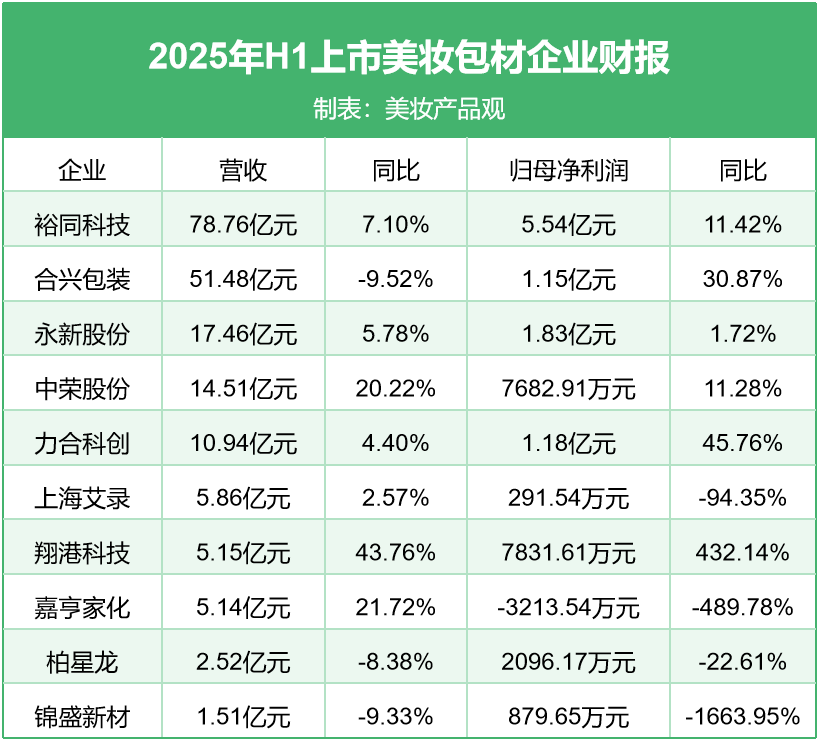
Yutong Technology ranks first in the industry with a revenue of 7.876 billion yuan, closely followed by Hexing Packaging with 5.148 billion yuan. Except for Yutong Technology and Hexing Packaging, the revenue of the other 8 companies has not exceeded 2 billion yuan, and Jinsheng New Materials' revenue scale of 151 million yuan is only 1/52 of Yutong Technology. The revenue gap between top and bottom companies has widened to about 50 times.
Behind this scale differentiation is the support of the multi category layout and global customer system of top enterprises.
Taking Yutong Technology as an example, its customers cover international luxury brands such as LV and Dior, as well as top local beauty companies, and extend to consumer electronics, food and other fields. Its risk resistance ability is significantly stronger than that of small and medium-sized manufacturers relying on a single beauty category; However, tail enterprises such as Jinsheng New Materials have weak bargaining power due to their products being concentrated in basic packaging materials such as glass bottles and hoses, making it difficult to break through the bottleneck of scale in market competition.
In terms of net profit, Yutong Technology still took the lead, reaching 554 million yuan. Secondly, Hexing Packaging, Yongxin Shares, and Lihe Sci Tech Innovation recorded 115 million yuan, 183 million yuan, and 118 million yuan respectively; Zhongrong Shares, Shanghai Ailu, Xianggang Technology, Jiaheng Jiahua, Baixinglong, and Jinsheng New Materials are all below 100 million yuan, especially Jiaheng Jiahua is the most dismal, with a loss of 32.1354 million yuan.
Among the 10 companies, 5 achieved a simultaneous increase in revenue and net profit, namely Yutong Technology, Yongxin Co., Ltd., Zhongrong Co., Ltd., Lihe Kechuang, and Xianggang Technology.
In terms of revenue growth, Xianggang Technology has the fastest growth rate, reaching 43.76%, followed closely by Zhongrong Shares with a growth rate of 20.22%. Yutong Technology, Yongxin Shares, and Lihe Sci Tech Innovation all have single digit growth rates of 7.1%, 5.78%, and 4.4%, respectively; In terms of net profit growth, Xianggang Technology is still far ahead, with a year-on-year surge of 432.14%, demonstrating strong growth momentum. Lihe Science and Technology Innovation also grew well, recording a growth rate of 45.76%. Yutong Technology and Zhongrong Shares have similar growth rates, with 11.42% and 11.28% respectively. Yongxin Shares has the slowest growth rate, with only a slight increase of 1.72%.
Shanghai Ailu and Jiaheng Jiahua have fallen into the dilemma of "increasing revenue without increasing profits". The former's revenue was 586 million yuan, an increase of 2.57%, while its net profit was only 1.9154 million yuan, a sharp drop of 94.35%. The latter's revenue increased by 21.72% year-on-year to 514 million yuan, but it incurred a loss of 32.1354 million yuan, a decrease of 489.78% year-on-year. Profitability is significantly under pressure.
On the contrary, Hexing Packaging "increased profits without increasing revenue", with a revenue decline of 9.52%, but a net profit of 115 million yuan, a year-on-year increase of 30.87%. The improvement of cost control ability and optimization of product structure have enabled Hexing Packaging to achieve profitable growth against the trend despite revenue contraction.
The most sluggish category of enterprises saw a decline in both revenue and net profit, including Baixinglong and Jinsheng New Materials, both experiencing single digit declines in revenue. The latter's net profit even plummeted by 1663.95%, indicating a decline in performance.
Price war squeezes profits
The industry's profit margin continues to shrink
Compared to brand owners and raw material companies, the beauty packaging industry has lower technological barriers and is more likely to fall into the vortex of homogeneous competition. In order to compete for limited market share, some companies have had to adopt the strategy of "exchanging price for quantity", which has sparked a fierce "price war" and ultimately dragged the entire industry into a quagmire of sustained pressure on gross profit.
After reviewing the gross profit margin data of the ten companies mentioned above, "Beauty Product View" found that in the first half of this year, the gross profit margin of beauty packaging companies was generally below 30%, with only Baixinglong's gross profit margin increasing by 7.71% to 36.5%, showing outstanding performance.
In sharp contrast, half of the 10 companies are facing the severe challenge of declining gross profit margins, including Yutong Technology, Yongxin Shares, Shanghai Ailu, Jiaheng Jiahua, and Jinsheng New Materials.
From the perspective of decline, Jiaheng Jiahua's gross profit margin experienced the most severe decline, reaching 23.92%, followed by Shanghai Ailu, which fell 22.97%, Yutong Technology and Yongxin Shares, which fell by single digits of 3.5% and 5.38% respectively. Although Jinsheng New Materials' net profit declined significantly, its gross profit margin only slightly decreased by 0.24%.
By delving into the reasons for the decline in gross profit margin, different companies have their own difficulties, but they also reflect common problems in the industry.
Jiaheng Jiahua stated in the announcement that there were changes in the product structure during the reporting period, coupled with an increase in fixed expenses such as depreciation and amortization of the Huzhou Jiaheng factory, which jointly led to a year-on-year decrease in gross profit margin; At the same time, the increasing competition in the industry has brought about gross profit pressure, which may force companies to compete for market share through price reduction strategies, further exacerbating their profitability difficulties.
Jinsheng New Materials directly points to the core pain points of the industry: on the one hand, the cosmetics packaging industry faces severe homogenization competition, and enterprises lack differentiation advantages; On the other hand, the fluctuation of raw material prices such as PMMA particles in the upstream brings cost pressure, while downstream customers continue to exert price pressure, resulting in a continuous compression of profit margins in the "up and down squeeze".
The decline in gross profit margin of Yongxin Co., Ltd. is directly related to the competition in its main business. The price war in the color printing business is intensifying, coupled with the increasing proportion of low gross profit products in revenue, which has jointly lowered the overall profitability level.
In fact, the "low gross profit" dilemma in the beauty packaging industry is not a short-term phenomenon.
Since 2021, due to multiple external factors such as macroeconomic fluctuations, changes in the international trade environment, and the impact of the pandemic, coupled with the continuous strengthening of price control by international and domestic brand customers on upstream packaging companies, the gross profit margin of packaging suppliers has entered a sustained contraction channel. Public data shows that the industry's average gross profit margin has declined from 25.28% in 2019 to 19.79% in 2023, a decrease of about 5 percentage points over the past five years, with a significant decline in profitability.
If the time dimension is extended to the past five years, the changes in gross profit margins of these 10 packaging companies can more intuitively reflect the industry's declining profitability. Among them, the gross profit margins of 8 companies showed a downward trend, with Zhongrong Shares, Lihe Sci Tech Innovation, Shanghai Ailu, Jiaheng Jiahua, Baixinglong, and Jinsheng New Materials experiencing particularly significant declines.
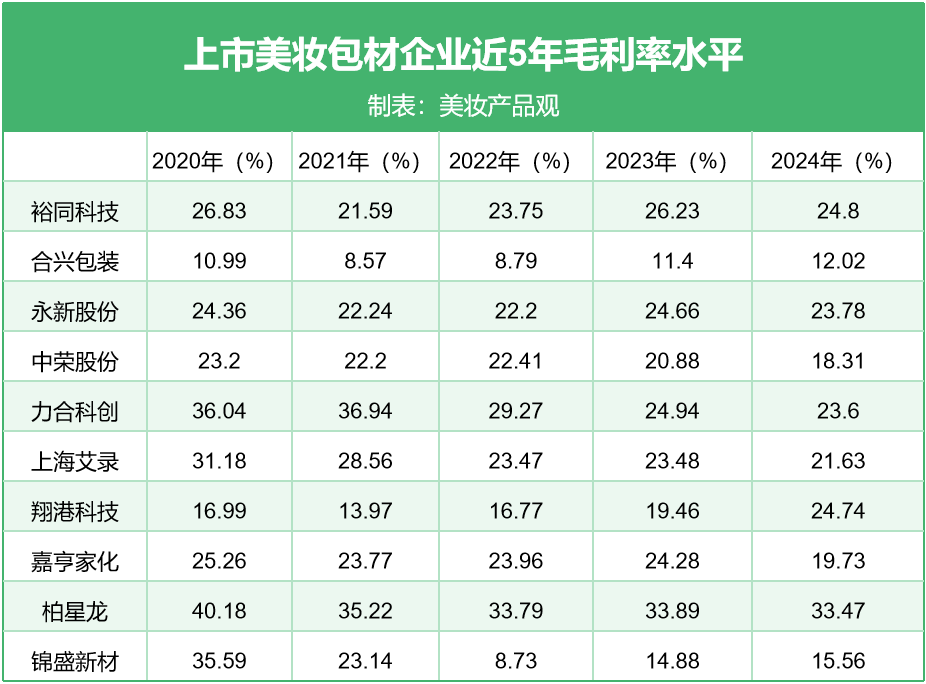
Taking Jinsheng New Materials as an example, the gross profit margin has declined from 35.59% in 2020 to 15.56% in 2024, with a sharp cut in gross profit margin over the past five years and a significant weakening of profitability.
However, "price reduction for quantity" is not the correct path for packaging companies to break out of homogenization and internal competition, and the case of Jiaheng Jiahua is the most vivid warning.
In the first half of this year, the revenue scale of Jiaheng Jiahua increased by 21.72% year-on-year to 514 million yuan, but the net profit did not improve accordingly, and instead continued to suffer losses, with a total loss of 32.1354 million yuan. It is worth noting that the net profit of Jiaheng Jiahua has continued to decline in the past three years, with a loss of 23.7 million yuan for the whole year of 2024.
Break out of the vicious cycle of 'involution'
When the old path of "exchanging price for quantity" is no longer feasible, the industry urgently needs to draw experience from companies with outstanding performance and explore a virtuous path to break through. The upgrading of intelligent manufacturing, the layout of green packaging materials, and the development of overseas markets are becoming the three core engines driving the industry to overcome difficulties.
Accelerate the upgrade of intelligent manufacturing and solve the cost dilemma through technological efficiency improvement
In the current context of rising labor costs and prominent production efficiency bottlenecks, intelligent manufacturing has become a key measure for packaging companies to reduce costs and increase efficiency.
After nearly two years of practice, Hexing Packaging has formed a more mature model and experience in the planning and design, equipment selection, implementation and deployment, and operation management of intelligent manufacturing.
For example, by upgrading production equipment and processes, the paper feeding process can be transformed into a vacuum adsorption feeding system, effectively reducing paper loss; Introducing equipment such as robotic arms and intelligent controllers significantly reduces labor costs while improving product quality and production economic benefits.
Adapt to environmental trends and create green packaging materials
The tightening of global environmental policies and the green demand in the consumer market are driving the transformation of the beauty packaging industry towards sustainability.
The EU's "Packaging and Packaging Waste Regulations" require a cosmetic packaging recycling rate of 70% by 2030, while China's "dual carbon" strategy aims to increase the proportion of bio based plastic applications from 18% in 2024 to 35% in 2030. As a cluster of China's beauty packaging industry, Yuyao City has guided three regulated enterprises to complete the "product label" certification through policies, promoting the use of biodegradable materials to 22%.
Shanghai Ailu Environmental Protection Product Innovation Breakthrough has launched the Espeed series of plastic free paper-based packaging products, which have won honors such as the "Technology Innovation Breakthrough Award", in line with environmental trends and may become a new growth point in the future.
Anchor overseas markets and seek new growth opportunities
The domestic market has entered an era of stock competition, and with weak domestic demand, "going global" has become an important breakthrough for packaging companies to seek new growth points.
Yutong Technology is a pioneer in global layout. As early as 2010, it established overseas factories in Vietnam and gradually deepened its global "smart manufacturing" network. As of the end of the reporting period, the company has established over 40 production bases and 4 service centers in 10 countries and 40 cities worldwide. In the first half of 2025, the company's overseas revenue was 2.823 billion yuan, a year-on-year increase of 27.21%, with a gross profit margin of 28.79%, significantly higher than the domestic business's 19.41%.
Yongxin Shares, Jiaheng Jiahua, and Baixinglong's overseas business also performed well, with year-on-year revenue growth rates of 39.67%, 114.39%, and 35.86%, respectively. Overseas markets have become a new engine driving performance.
It is generally believed that overseas markets not only have a better competitive landscape, but also have a strong demand for high-quality packaging materials, which can provide enterprises with higher bargaining space and become a new driving force for performance growth.
Nowadays, the beauty packaging industry is standing at a critical transformation point, and the net profit fluctuation and gross profit contraction brought about by the "price war" have proven that homogeneous competition cannot drive the industry upwards. In the future, only by breaking out of the homogenized price war and focusing on the core of value creation can enterprises truly break out of the vicious cycle of "internal competition".