


The 'three-step secret' to the long life of patterned rollers - how many steps are you doing correctly?
Anilox rolls, also known as screen rolls or ink transfer rolls, are used to control the quantitative output of ink or coating. As the core of flexographic printing, anilox rolls play an indispensable role in the production process, and their maintenance and management are also very important. In this article, the author combines years of work experience to detail some key points in the maintenance and management of anilox rolls, hoping to be beneficial to readers.
Generally speaking, to properly manage anilox rolls, one needs to perform cleaning, inspection, installation, and storage tasks well.
01
Anilox Roll Cleaning
If an anilox roll is not cleaned promptly after use or not cleaned thoroughly, it may become clogged during the next use. Clogging can lead to a reduced ink volume on the roll, color variations, difficulty in matching samples, and significant waste for the company. Therefore, anilox roll cleaning should follow the principle of "clean immediately after use," which is key to keeping the anilox roll in good condition.
Currently, common cleaning methods include particle blasting, manual cleaning with effective and safe cleaning agents, laser cleaning, and ultrasonic cleaning, as shown in the figure. Each cleaning method has its advantages and disadvantages, and the choice should be determined by the printing company according to its own circumstances.
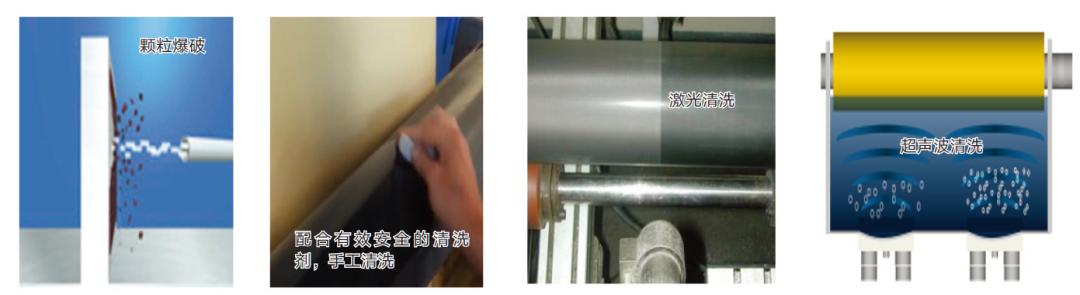 Common cleaning methods for anilox rollers
Typically, cleaning of anilox rollers is divided into three stages: daily cleaning, regular cleaning, and deep cleaning. Generally, routine cleaning-that is, after printing stops each day or when replacing anilox rollers during order changeover-requires immediate cleaning of used anilox rollers; Regular cleaning, meaning that the anilox roller that has been in use for 2~4 weeks should be given a more thorough cleaning; Deep cleaning refers to deep cleaning of anilox rollers that have been in service for more than 4~8 weeks. This cleaning requires strict operation of the cleaning process on the anilox roller cleaning equipment.
During cleaning, try to use cleaning agents with a pH within the range of 8~10, and avoid highly corrosive cleaners; The temperature of the cleaning agent for equipment cleaning should be controlled between 35°C~45°C; The concentration of cleaning agent should not be too high; it is recommended to mix one part cleaning agent with 4~10 parts water; After cleaning, rinse with clean water and dry with an air gun; If special stains appear, clean and treat them immediately.
Currently, most printing companies have a deep understanding of the concept of cleaning anilox rollers, but it is difficult to achieve thorough cleaning. Many times, customers pay close attention to cleaning the anilox rollers, and upon arrival, they find that they have indeed been cleaned, but they have not done thorough cleaning; only the surface is very clean.
Once, a customer went to test their anilox roller on site and found it severely clogged; they only cleaned the surface very thoroughly. Three states of this anilox roller were tested. Figure (a) below shows an anilox roller cleaned by the printing company itself, with a cavity depth of 16μm and an ink volume of 4.5cm3/m2; Figure (b) below shows manual cleaning using cleaning solution. The test results after cleaning are cavity depth 18μm and ink content 5.6cm3/m2; Figure (c) below shows cleaning in ultrasonic equipment, with cavity depth of 22μm and ink flow of 6.8cm3/m2. It can be seen that printing companies believe that the anilox rollers that have been cleaned have a 50% increase in ink load after thorough cleaning.
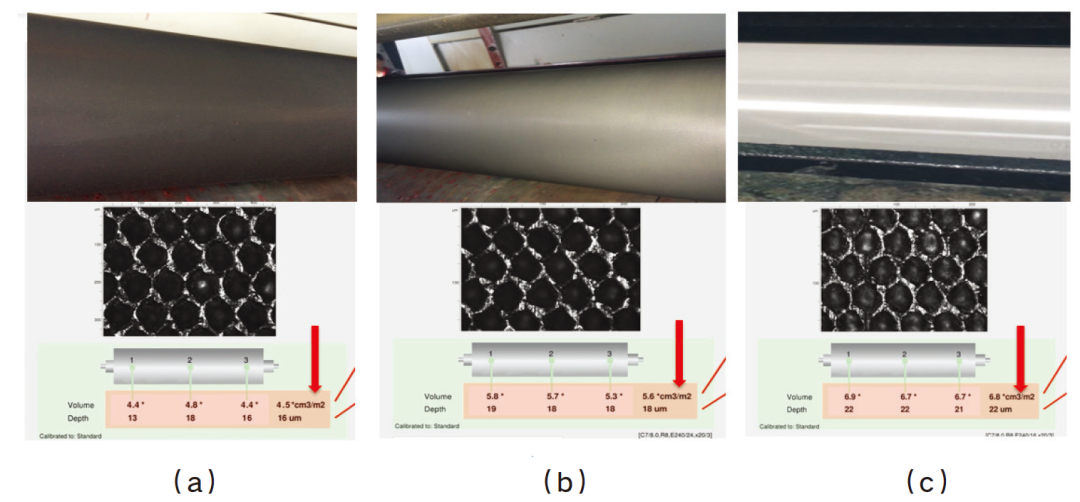
Different Cleaning Methods Result in Different Cleaning Effects
It can be seen that maintaining daily cleaning, adhering to regular cleaning, and performing proper deep cleaning are key to extending the life of anilox rollers and improving printing efficiency. At present, most printing companies have not yet tapped into the potential of high-quality anilox rollers. Therefore, starting with proper anilox roller cleaning work is believed to bring printing companies returns far exceeding the investment of a single anilox roller.
02
Regular Inspection of Anilox Rollers
When a new anilox roller arrives at a printing company, it usually comes with initial test data. However, during use, pore blockage and wear caused by prolonged high-speed contact with the doctor blade inevitably reduce the ink-carrying capacity. Different ink volumes (cm³/m²) will result in noticeable color differences when printing with the same ink, as shown in the figure.
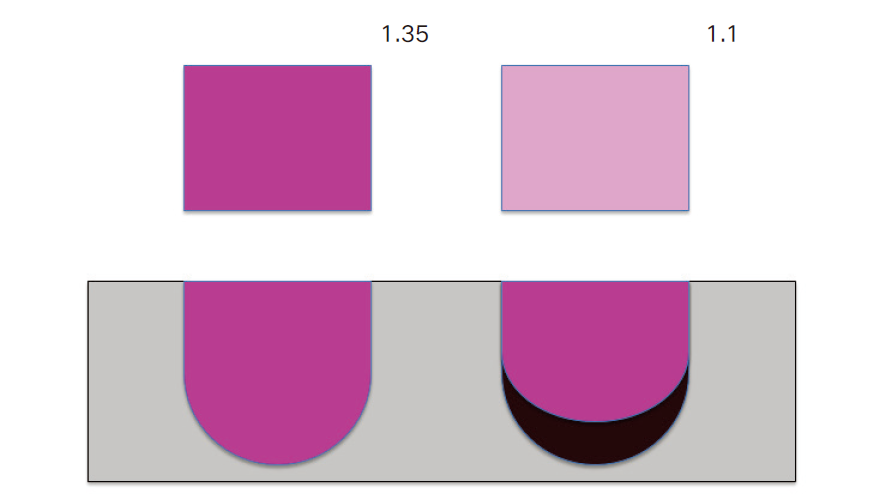
Clogged mesh holes lead to a decrease in ink carrying capacity, causing color differences in printing.
Therefore, after cleaning the anilox roller thoroughly, it is necessary to perform the required inspections in preparation for the next use. Generally, there are two methods: visual inspection and inspection with a testing device. Visual inspection mainly checks whether the surface of the anilox roller is clean and whether there is any damage or abnormalities. Using a testing device primarily checks if the cell bottoms of the roller are clear, whether the cell walls are intact and worn, and records the results accordingly. In addition, anilox rollers that are stored and not used for a long time should also undergo regular inspections.
03
Proper Installation and Storage
Improper installation or removal, as well as unsuitable storage conditions, can easily cause anilox rollers to wear, deform, or be damaged, reducing their service life. Therefore, during daily operation and storage, anilox rollers should be placed in specialized boxes or appropriate racks, stored in dry, ventilated indoor environments, and protected with sleeves. When replacing anilox rollers, avoid collision with other hard objects. When handling, use dedicated transport carts to prevent the rollers from falling due to their weight, thus avoiding most accidental damages.
In summary, correct and comprehensive management of anilox rollers can extend their service life, ensure stable production, and bring significant cost savings to printing companies. Proper management of anilox roller ink volume can reduce the number of sample runs, save time that could be used to produce an additional order, and make the standardization of the flexographic printing process easier.