


Say goodbye to color mismatch headaches! How can digital printing seamlessly connect with traditional offset printing?
In the printing industry, color consistency and stability are at the core of improving product quality and customer satisfaction.
Digital printing technology, with advantages such as high efficiency, on-demand printing, and personalized variable data printing, has developed rapidly and is widely applied in recent years. With technological advancements, the quality of printed products continues to improve, creating huge market potential. In the future, digital printing will complement traditional printing, jointly driving the industry toward scientific, energy-saving, and environmentally friendly development.
Although digital printing is highly integrated in workflows and has simpler and smarter color control, its color management principles and methods are basically consistent with traditional printing. The main steps include the following steps: linear calibration of digital printing equipment (using TVI or G7 methods), total ink volume control, collection and establishment of equipment characteristic data, matching reference characteristic data (via ICC conversion or CMYK-CMYK 4D spatial conversion), and cyclic calibration. To improve color quality, equipment manufacturers continuously optimize the color control modules of their DFE (Digital Front-End) printing servers, whether through independent development or by introducing third-party color control engines, all striving to achieve more precise color performance.
However, many companies still face color management challenges: lack of unified standards leads to inconsistent colors, unstable quality, low mixing efficiency, and high costs. Even with external experts, results are hard to sustain. How to manage color well and achieve seamless switching between traditional offset printing and digital printing has become an urgent challenge for major printing companies.
Next, I will use the Landa digital printing machine as an example to briefly explain how traditional offset printing transitions to digital printing. Before understanding the following cases, it is necessary to grasp some basic principles of color management. Landa digital printing machines have a wide color gamut and high color saturation, which traditional offset printing cannot match. If the order is large and may switch back to traditional offset printing in the future, then documents need to be processed in advance. The specific method is to use the small color gamut of the Landa digital printing machine for prototyping and production of small-batch orders at the front end, that is, to find the corresponding positions of the primary colors within the color gamut space of the Landa digital printing machine. This way, when switching back to traditional offset printing, it becomes easier to achieve color matching and consistency.
Establishment of the color gamut space of Landa digital printing machines
Before carrying out related work, equipment must first undergo standardized calibration. After calibration, professional color management software systems such as ORIS CGS X Gamut or EFI Fiery are used to quantify and acquire device features.
01
Acquisition device features ICC: EFI Fiery color matching method
Using the Color Profiler Suite (CPS) from EFI Fiery in the Landa digital press to capture ICC, and using CMYKOGB 7C to capture the device's maximum color gamut space, this is the device feature ICC of the Landa digital press.
Step 1: Linearization (equipment condition inspection and calibration)
Step 2: Ink total limit (Landa digital printer only requires 220%)
Step 3: Color reference (whether the 7C gradation curve matches naturally)
Step 4: Maximum color gamut collection (2700 color blocks)
02
Matching the color standard target
In EFI Fiery, the CMYK target ICC must correspond to the actual paper ICC used. If the purchased paper fully meets the standard white paper, the corresponding standard in Fogra or GRACoL can be used directly. Otherwise, it is recommended to modify the target ICC based on the actual paper white, generate a new ICC, and then apply it. The color parameters are set as shown in Figure 2.
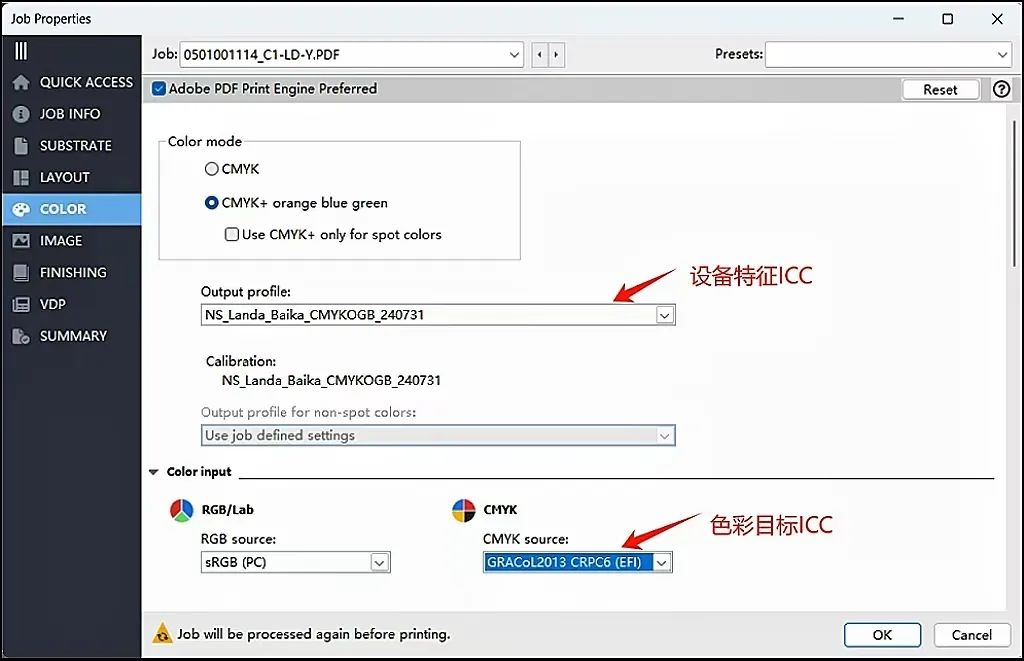 Figure 1 Color Parameter Settings in EFI Fiery
By correctly setting and printing the TC1617 chart, you can use professional color evaluation software like Curve to check whether the printing targets meet all the indicators. We verify according to the IDEAlliance G7 specifications. If it shows PASS, it means all color indicators meet the standards and align with the color targets.
At this point, printing production can proceed according to the matched color targets.
Establishing Traditional Offset Printing Color Gamut
A professional color management software system like ORIS CGS X Gamut is needed to establish it. The process is basically the same as Landa Digital Printing, so we won't repeat it here.
Conversion Applications Between Digital Printing and Traditional Offset Printing
Color Matching Method for CMYK Four-Color Overprinting
01
First Production of a New Order
For new orders, there is no issue of comparing old and new product colors for the customer, which makes it easier to handle. It only needs to address whether future conversion to offset printing is necessary. Early on, it's important to understand whether the customer requires European standards Fogra39, Fogra51, or American standards GRACoL2006, GRACoL2013 targets. If future conversion to traditional offset is needed, production should use a small-gamut ICC; otherwise, you can directly use the Landa Digital Press ICC, enjoying the high-saturation visual effect of Landa Digital Press colors.
02
Traditional Offset CMYK and Spot Colors Converted to Digital Printing
Shenzhen Jiuxing Printing & Packaging Group Co., Ltd. uses the CGS color management system. First, the file colors are pre-adjusted through the Epson prepress digital proofing system to ensure both visual inspection and data measurements meet requirements, then transferred to the Landa Digital Press for plate-making production. During this process, previously created ICC files for traditional offset and Landa Digital Press are used to establish a correspondence between the two color spaces via CGS software, directly matching the Landa Digital Press ICC to the printing target ICC, i.e., Landa Digital Press 7C.icc -> CMYK.icc. Since the Landa Digital Press has a relatively large color gamut, it can find a corresponding relation within its range to achieve color consistency.
Current color management processes are highly intelligent and achieving expected results can be done following standard procedures. The ink gamut used by Landa Digital Press can cover 96% of the Pantone color library, with color differences optimized to ΔE≤2. By using CGS X Gamut tools, spot colors can be pre-matched and their feasibility assessed before production, identifying the 4% of spot colors that cannot be matched. Furthermore, since the Lab values of paper affect spot color results, Jiuxing Printing has established ICC files for various types of paper and set up corresponding paper conversion queues in CGS X Gamut, fully leveraging the software to efficiently manage spot colors, ensuring accurate and stable color output.
For full details of this case, check out: "How to Do Color Management in Digital Printing? Tips from Jiuxing Printing."
In addition, many companies still face difficulties in color management: lack of unified standards leads to inconsistent colors, unstable quality, low color adjustment efficiency, high costs, and even with external experts, results are hard to maintain.
Even with significant investment in color management, problems persist, and overall equipment effectiveness (OEE) hasn't improved. The reason is that while color stability and consistency can be technically solved, the key lies in management methods. The core of color management is a systematic management framework, rather than just relying on technology. Lack of systematization is the fundamental reason for ineffective results.
To help printing and packaging companies eliminate pain points and strengthen employee digital prepress skills, Keyin Media will hold the 2025 Printing and Packaging Color Management Training Camp from March 27-29. The program includes "course explanation + hands-on practice," allowing participants to learn, practice, and master digital color management methods suitable for the domestic printing and packaging industry, complete the full digital color management process, analyze and solve problems independently, maintain long-term stable print quality and efficient production, and quickly elevate their company's digital technology level.