


Work efficiency boosted by over 300%! The new cigarette pack inspection device is this efficient!
Currently, the testing of adhesive performance for finished cigarette packaging is completely manual. The testing process includes three main steps: material preparation, paper bonding, and peel-off evaluation, involving more than ten procedures such as sample cutting, glue application, pressing, resting, peeling, and assessment, all of which rely entirely on manual work. This traditional testing method has issues like inaccurate glue amounts, uneven application, misaligned paper, and insufficient pressing, leading to long testing times, frequent retests, high labor intensity, low efficiency, and safety risks with some heating equipment. To address these problems, Changde Jinpeng Printing Co., Ltd. (hereinafter referred to as "Changde Jinpeng") adopted a "joint breakthrough by upstream and downstream industry chain enterprises" approach. By learning on-site and innovating together, they successfully developed a device for testing the adhesive performance of packaging paper. This article systematically explains the development background, technical solutions, implementation effects, and potential applications of this device, aiming to provide a reference for technological innovation in quality testing in the industry.
Technical Background and Problem Analysis
01/ Technical Connotation of Adhesive Performance
Adhesive performance refers to, based on the mechanism of bond failure, simulating the bonding step in cigarette packaging formation, where two samples are bonded and then destructively peeled apart. If the paper fibers are pulled apart by the glue, the adhesive performance is considered qualified. This performance indicator directly reflects the compatibility between the adhesive and the paper substrate and is a key parameter for ensuring the stability of the packaging structure.
02/ Traditional Testing Methods and Existing Problems
Currently, all cigarette box packaging products must undergo adhesive performance testing before leaving the factory. The testing process can be divided into three main stages: "material preparation," "paper bonding," and "peel-off evaluation." The specific procedure includes: take the sample to be tested from the sample bag → cut the adhesive area of the sample to a 20mm×50mm size → draw glue with a syringe (as shown in Figure 1) → drop glue on the designated area → spread the glue evenly with a clean dropper → align and attach the back of the paper with the glued area → press with a heat sealing device (as shown in Figure 2) → lay flat and let sit for 30 minutes → manually peel apart the two bonded surfaces completely → visually assess whether the paper fibers are damaged.
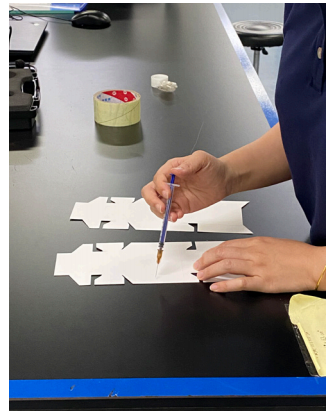
Figure 1 Manual Suction of Gel
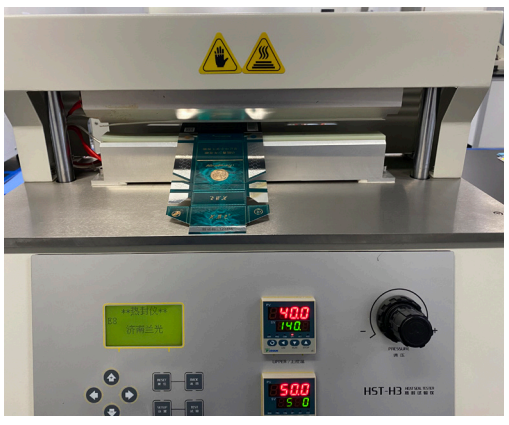 Figure 2 Hot Sealing Press
After analysis, the above fully manual operation process has the following problems:
(1) Low efficiency: Single tests in the laboratory take too long, with the full process taking about 35 minutes. After a request for inspection, there's a long wait for feedback, which can't meet real-time production monitoring needs.
(2) Safety hazards: Some testing steps involve heating equipment, and manual operation carries risks of burns and electrical hazards.
(3) Insufficient accuracy: Current testing methods are relatively rough. Glue amount control relies on operator experience, and uniformity of coating can't be guaranteed, leading to low precision in test data, making it difficult to support refined quality control.
(4) High reinspection rate: The whole process is performed manually, and key steps (like scraping glue, aligning, and pressing) are prone to errors, causing experiment failure. The reinspection rate is as high as 50%, which not only increases workload but also wastes testing resources.
In summary, traditional manual testing methods are no longer suitable for the modern cigarette pack industry's requirements for precise and efficient quality control. There is an urgent need to develop a standardized, automated testing device to fundamentally eliminate human interference.
Solution and Technical Principles
01/ Research Goals and Overall Approach
To address the above issues, our project team set the following development goal: to develop a packaging paper adhesive performance testing device that standardizes and automates the testing process, effectively controls the amount and uniformity of glue applied, ensures safe and firm heated pressing, and significantly improves testing efficiency and data reliability. The overall technical approach is to integrate functions such as glue scraping, transferring, heating, and pressing into a single device, converting scattered manual operations into a continuous automated process; achieve precise control of key process parameters through a precise mechanical structure; and eliminate human factors through standardized operating procedures.
02/ Device Structural Design
The developed packaging paper adhesive performance testing device belongs to the field of packaging bonding technology and mainly includes three functional modules, as shown in Figure 3.
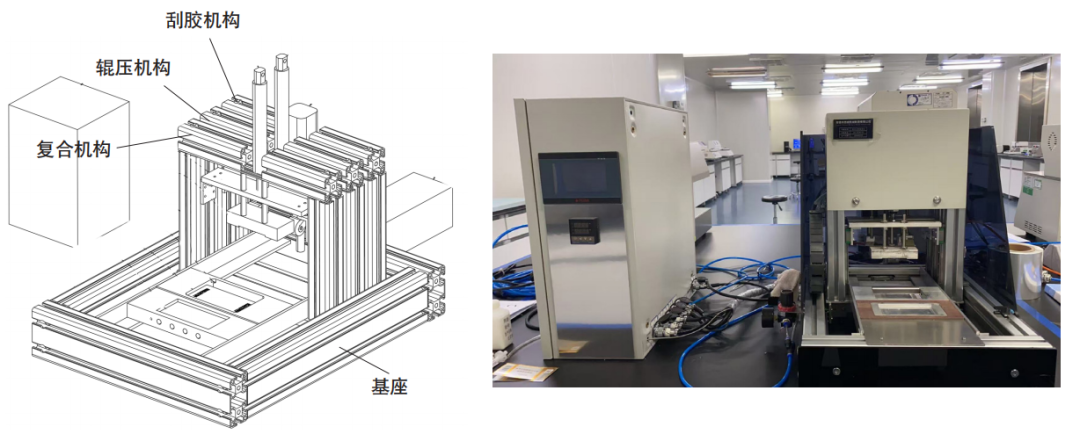 Figure 3 Packaging Paper Adhesive Performance Testing Device (left: schematic diagram, right: real device)
(1) Base: Serves as the supporting platform for the entire device, integrating the installation of the scraping mechanism, rolling mechanism, and lamination mechanism. It ensures the spatial positioning of each functional module is precisely coordinated, enabling continuous testing processes.
(2) Scraping mechanism: Used to scrape excess glue from the glue brush trough into the overflow trough and level the glue. This mechanism features a precise scraper gap adjustment device to control the glue layer thickness within a preset range, ensuring uniform and consistent thickness.
(3) Rolling mechanism: Used to press the packaging paper onto the glue layer after scraping, transferring the glue to the paper. The mechanism is controlled by a drive unit that ensures the roller applies constant speed and pressure, eliminating speed fluctuations and uneven pressure caused by manual rolling.
(4) Lamination mechanism: Used in adhesive tests to apply controlled lamination pressure and time to the paper that has been glued and transferred to the lamination trough, simulating the lamination process in actual printing and packaging production. This mechanism includes an electric heating module to precisely control pressing temperature and time.
03/ Standardized Testing Process
Based on the developed device, the following standardized testing process was established:
(1) Sampling: At least 5 sheets should be sampled per batch. Samples should be flat, undamaged, free of sticking, and meet the size requirement of at least 300mm × 300mm. Each sample should indicate the paper grain direction and front/back sides, and be sealed in a bag.
(2) Temperature and humidity conditioning: Samples should be conditioned under the conditions specified in GB/T 10739 to eliminate environmental influences on the results.
(3) Sample cutting: Cut the samples into Sample 1 (98mm × 42mm) and Sample 2 (98mm × 50mm), ensuring the long side (98mm) is parallel to the grain direction for consistency with the force direction during actual production.
(4) Glue injection: Use a glue dispenser to draw a measured amount of test glue and inject it into the dot glue reservoir of the glue application module.
(5) Glue scraping: The scraper automatically scrapes excess glue around the dot reservoir into the overflow trough and levels it, forming a uniform glue layer.
(6) Glue application: Place Sample 1 (98mm × 42mm) into the glue application module with the paper front facing up. Start the rolling mechanism to press the sample onto the leveled glue layer at constant speed and pressure, ensuring even glue transfer.
(7) Adhesion: Remove the glued Sample 1 and place it in the electric heating module's groove of the bonding module, glue side up, aligned with the front side of Sample 2. Set the electric heating module temperature and start the hot-press device to press Sample 1 and Sample 2 together.
(8) Sample installation: Take the bonded sample from the glue application device. Insert one end of Sample 2 into the fixed slot of the peel tester and clamp the other end of Sample 1 with the traction fixture.
(9) Peel test: As shown in Figure 4, use a 150° peel angle and a testing speed of 600mm/s with the traction fixture. Record the peel force curve and determine the failure mode (paper fiber failure or glue layer interface failure).
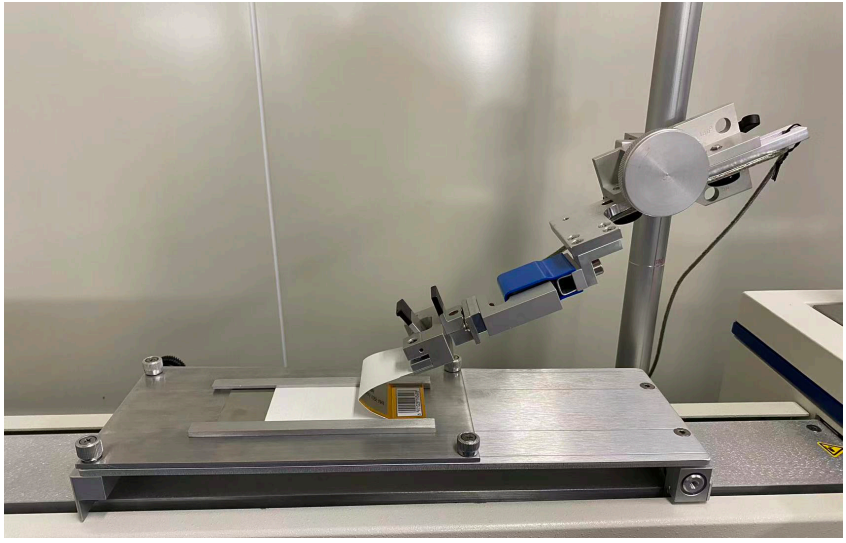
Figure 4 Cigarette Pack Peeling Test
04/ Key Technology Breakthroughs
This device has achieved technological breakthroughs in the following three areas:
(1) Integrated Design: By integrating the three main functional modules-glue scraping, rolling, and laminating-into a single base, it standardizes the entire process in adhesive performance experiments, including applying glue, leveling the adhesive layer, transferring glue, and laminating, eliminating errors between steps.
(2) Precise Parameter Control: The scraping mechanism ensures the adhesive layer is uniform in thickness (error ≤ 0.01mm); the rolling mechanism, driven by a servo system, controls the rollers to transfer the adhesive at a constant speed and pressure, with speed accuracy of ±0.1mm/s and pressure accuracy of ±0.5N; the laminating mechanism can precisely adjust laminating pressure (±1N), temperature (±1℃), and time (±0.1s), accurately simulating actual production conditions.
(3) Standardized Operation: All operations are set through a human-machine interface, and after one-click start, the entire process is completed automatically. This completely eliminates defects caused by manual operation, such as inaccurate glue amount, uneven application, misaligned paper, or insufficient pressing, ensuring the repeatability and comparability of the test results. The comparison of the before-and-after testing process is shown in Figure 5.
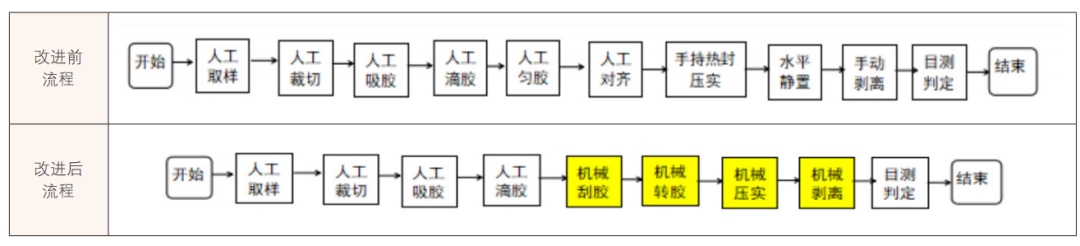
Figure 5 Comparison of inspection processes before and after improvement
Technical Effectiveness and Data Analysis
01/ Efficiency improvement analysis
After multiple hands-on validations and practical tests, the device has achieved significant improvements in inspection efficiency. The total inspection time per pass has been reduced from 2057 seconds in traditional manual methods to 442 seconds, increasing work efficiency by 365.38%. The success rate for the entire inspection process has reached 100%, and the re-inspection rate has dropped from 50% to 0, greatly reducing the labor intensity of testing personnel.
02/ Detection accuracy and reliability
Customer Evaluation: "This device is scientifically and reasonably designed, easy to operate, highly accurate, and highly stable. It effectively overcomes issues such as detection lag and data bias found in previous manual inspection methods, providing strong technical support for our efforts to strengthen quality control of packaging paper adhesive."
03/ Security improvements
Traditional manual testing uses heat sealers and other heating equipment with burns and electrical safety risks. This device integrates the heating module into a closed composite mechanism, featuring thermal insulation protection and automatic temperature control, so operators do not need to touch high-temperature components, completely eliminating the risk of burns.
Social benefits and application value
01/ Direct economic benefits
This device can effectively reduce the rate of scrap and rework losses in packaging production by predicting paper bonding effects in advance. According to estimates, if this device is promoted across the industry, the finished product scrap rate caused by adhesive issues in packaging packaging companies can be reduced from an average of 5.7% to below 2%. At the same time, improved inspection efficiency can save a significant amount of labor costs, reducing labor costs per inspection by about 80%.
02/ Technological leadership role
The standardized operation of this device can measure the bonding performance of different types of glue, efficiently select and adapt glue formulations for specialized cigarette pack paper, ink, and lamination processes, shorten the R&D cycle for glue selection and formulation improvement, precisely solve practical issues such as desticking, warping, glue overflow, and adhesion in cigarette pack production, and establish an evaluation system for the compatibility of glue and cigarette pack paper.
03/ Industry chain synergy
The project adopts a joint research model across the industry chain, integrating upstream glue R&D, midstream cigarette pack printing and production, and downstream cigarette packaging manufacturers with technical, talent, and equipment resources. It breaks down information and technical barriers at each stage, forming a full-chain technical optimization system from raw materials to finished products, driving the overall cigarette pack industry toward greater efficiency, precision, and intelligence, and enhancing the industry's core competitiveness.
04/ Contribution to industry standardization
This project successfully developed the country's first packaging paper adhesive performance testing device, achieving an industry first. To meet the unified technical specifications required by different enterprises and testing institutions within the industry, the project team standardized the research results, promoted technical breakthroughs and quality improvements in folding cartons and raw and auxiliary materials (paper) in the packaging and printing industry, and enhanced the coordinated allocation and innovation capabilities of upstream and downstream enterprises.
In the future, the research team will continue to optimize the device's intelligence level, develop an automatic judgment system based on machine vision, achieve fully unmanned operation of adhesive performance testing, and explore expanding the device's application to other packaging materials (such as plastics and metal foils) for adhesion performance testing, making greater contributions to technological innovation in quality inspection in the packaging industry.