


Ink imbalance is not scary! Do this for dirty printing plates
Ink balance is both the foundation and the difficulty of offset printing. According to the author's understanding, the key to ink balance is the control of water, on the one hand, the ratio of water, temperature and circulation cleaning; On the other hand, the correct regulation of the waterway system. In general, the former is almost static and does not change much; The latter is dynamic, with many variability factors and is not easy to master, so that printing often has dirty plates.
What exactly causes dirty editions?
According to practical experience, the author has made a simple analysis, which is roughly divided into: greasy and dirty version, small water volume dirty version, light water roller pressure dirty version, water roller runout dirty version, water roller poor water uniformity dirty version, etc. It can be said that most of them are caused by improper adjustment of the water roller. Therefore, the author will talk about some of my experiences based on two typical cases I have encountered recently.
Dirty plate caused by poor water evenness in the water roller
01 Fault phenomenon and solution
When we printed the cover of the textbook "Ethics and the Rule of Law", we found that there was a trace of straight line dirt on the magenta plate, and it was relatively evenly distributed, and the entire pattern was almost like this from beginning to end.
If the amount of water is intentionally increased, the dirty phenomenon will improve slightly, but it cannot be completely eradicated. Obviously, the root cause has nothing to do with the amount of water. Since the cover picture is snow blue, the blue and magenta are full-page flat screens, which is difficult to print. After the captain initially adjusted the ink roller, the dirty phenomenon still did not improve at all. So everyone began to suspect other reasons:
Is the quality of the alcohol-free dampening liquid unstable?
Is there a pockmark on the ink roller?
Is it calcification of ink rollers?
A series of question marks make people unable to start, and even some comrades are impatient, thinking that the quality of the product is okay and there is no need to be too serious.
As we all know, if you want to improve your operational level, you must learn to constantly analyze and solve problems in your daily work, especially difficult problems, and resolutely not give up easily.
Based on this belief, we checked the ink rollers one by one again, carefully adjusted the ink rollers, string rollers, and printing plates, but found no obvious abnormalities.
Later, we shifted the focus to the waterway, removed the metering roller, and adopted the method of "ink bar", and found that the pressure of the plate water roller on the string water roller was less than 2 mm, and the pressure was obviously not enough, so we added some pressure at both ends to make the ink bar reach 7 mm.
After turning it on again, the fault disappeared, and the printed magenta net was very clean and plain, and the ink color remained basically stable.
02 Fault analysis
From the analysis of the ink path: the ink has been repeatedly moved and stretched by the ink roller, and it is impossible to form traces of dirt and wisps.
From the waterway analysis: during the printing process, if the water is dirty due to the small amount of water, its manifestation is basically local, from the mouth to the mouth, and the tip part will hardly be dirty. At this time, as long as the water volume is appropriately increased, it can be solved.
Obviously, this failure is not simply a small amount of water, but a more complex reason. In order to clarify the causes, it is necessary to conduct a careful analysis of the waterway transmission (as shown below).
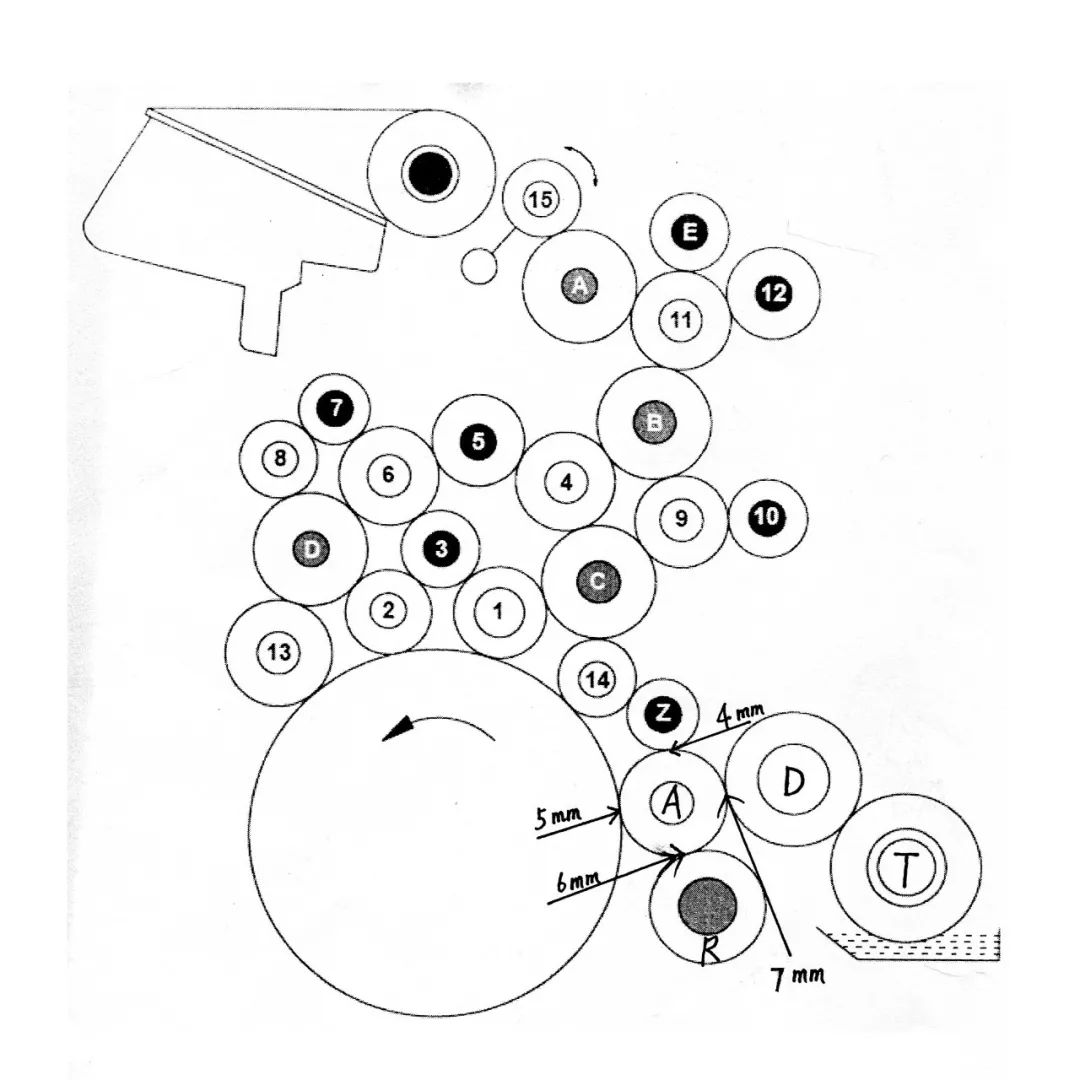
The fountain roller (T), metering roller (D), and plate-facing water roller (A) all supply water to the printing plate in a straight line at a uniform speed, while only the oscillating roller (R) moves back and forth in small amplitudes.
The key to the above fault is that when the pressure between the plate-facing water roller and the oscillating water roller is significantly low, the operation of the plate-facing water roller almost relies on the rotation of the printing plate cylinder, causing the water film on the plate surface to not be evenly spread by the oscillating roller. As a result, the printed dots are very regular, showing a shallow, cloth-like dirty pattern from start to finish.
Dirty plate caused by roller bounce
01 Fault Phenomenon and Solution
During a certain printing process, it was found that the magenta group often inexplicably carried dirt about 10 centimeters from the gripper edge, as shown in the figure below.
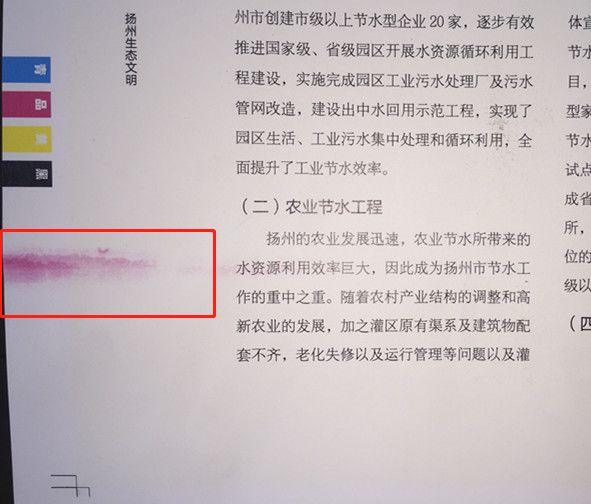
After investigation, it was understood that this situation had been occurring for several days. We deliberately slowed down the machine and increased the water flow, which made the effect barely acceptable. However, running the machine in such a precarious state is not a long-term solution, and it is necessary to find the cause as soon as possible.
Upon careful observation, we found that the roller shaft bearing of this color group's dampening roller had obvious vibration, and we initially suspected that the roller might be applying excessive pressure to the printing plate. So we stopped the machine for inspection, but everything seemed normal.
Could a fastening screw have come loose somewhere?
After checking, everything was normal.
Could the hydraulic cylinder prop rod have loosened?
By manually pushing the cylinder prop rod, we found the rod was indeed loose. Because when the cylinder is in normal working condition, it is practically impossible to move the prop rod back and forth easily by hand. This led us to conclude that the cylinder's seal was leaking, preventing the roller shaft bearing from operating stably. We immediately replaced the cylinder, and the problem was resolved.
02 Fault Analysis
In the fault described above, the dirty print appeared in the upper part of the gripper edge. When the machine speed was slowed, the vibration of the roller gradually decreased, and the dirty print issue improved. This is entirely different from the dirty print commonly caused by insufficient water supply.
The causes of roller vibration, apart from cylinder air leakage, include many factors:
(1) Excessive pressure of the roller on the printing plate;
(2) Worn roller bearings, causing play;
(3) Poor fit between the roller shaft end and the bearing housing, causing wobble;
(4) Loose or missing fastening screws;
(5) Poor manufacturing precision of the roller, causing it to be out-of-round.
In actual production, there are many other causes for dirty prints. It is not always due to insufficient water supply. If the operator mistakenly increases the water supply, it will inevitably cause ink-water imbalance, leading to a series of problems. Therefore, only by truly mastering the correct adjustment and use of the offset press water system can one truly control ink-water balance and print better products.