


Handling a Die-Cutting and Sheet Misalignment Issue on an Offset Press – Quick Guide!
During production, stable paper feeding is closely related to consistent production quality. If the paper feed is not smooth, it can cause many problems, such as an inability to reach the required machine speed, compromised production capacity, and difficulty in maintaining ink-water balance, ultimately affecting the quality of the printed materials.
Recently, our company's CD102-5 L Heidelberg five-color long-format press experienced the following issue: when the machine speed exceeded 7000 sheets per hour, paper ejection became skewed, which then continuously caused misalignment and machine stoppages, preventing smooth production.
To address this issue, we first checked the paper discharge timing. Pressing the paper feed button, we slowed it to 40.3°, then inserted a test pin into the feeder wall plate and found that the pin could pass smoothly through two cam holes and enter the feeder wall plate hole (Figure 1), indicating that the paper discharge timing was correct. Next, we checked the single-side paper feed speed adjustment mechanism and found no issues. We then checked whether the pressure on the paper discharge rollers was consistent, and it was fine. After turning on the air pump, we observed that the paper feed suction nozzles were working in sync. Continuing the check, we ran the machine in slow mode to eject paper continuously, and still found no obvious problems.
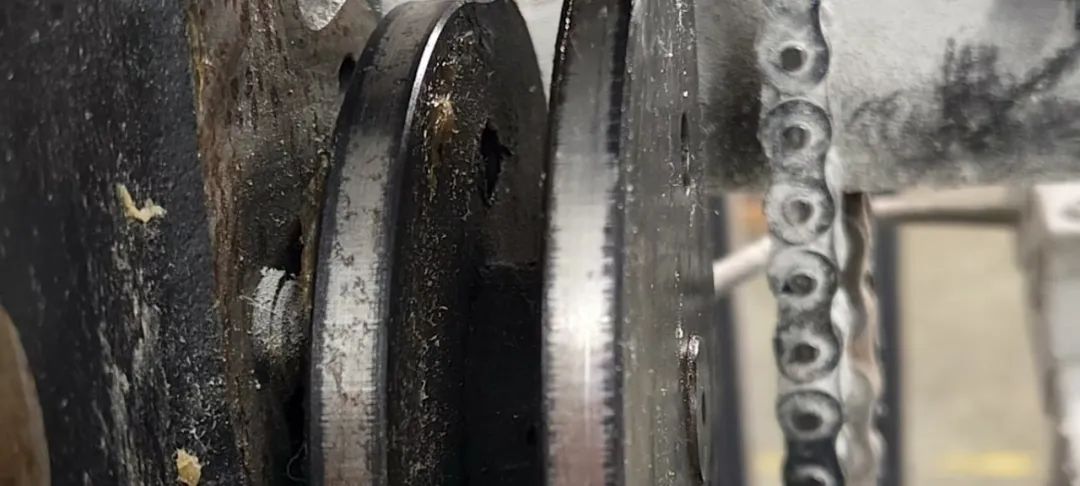 Figure 1 Detection Pin Passing Position
We again ran the machine idle and pressed the paper feed button, accelerating to 11,000 sheets per hour, occasionally feeling slight vibrations. After decelerating and stopping, we checked the feeder again and finally found the problem. When holding the two paper feed suction nozzles by hand, we found slight front-to-back movement. Further inspection revealed that the problem was with the connecting component between the paper feed suction nozzle rod and the transmission rod. This component was worn (Figure 2), creating a gap between the transmission rod and the paper feed suction nozzle rod, which caused the movement. At low speeds, the vibration amplitude was small and did not affect normal paper feeding, but as the speed increased, the vibration amplitude grew, eventually affecting normal paper feeding. The problem location is shown in Figure 3.
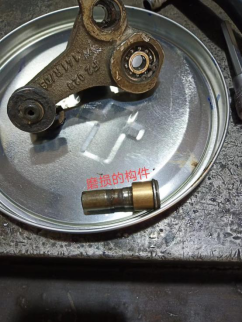
Figure 2 Worn Component
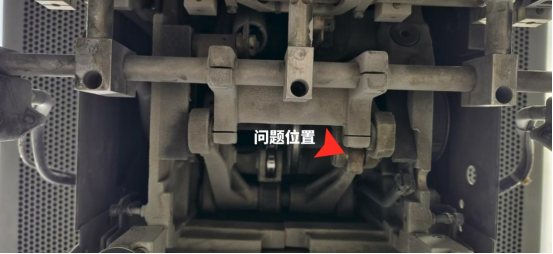
Figure 3 Problem Location
To verify our judgment, we used a rubber band to pull one side of the paper feeding suction nozzle, using the elasticity of the rubber band to offset the effects of the suction nozzle's uneven speed caused by shaking. At the same time, we increased the machine speed to 11,000 sheets per hour, and the equipment was able to feed paper smoothly.
Having identified the problem, we immediately resolved it by replacing the parts and performing a thorough dust removal and maintenance on all internal components of the feeder head. During the trial paper feeding, the machine speed was adjusted to 13,000 sheets per hour without any issues (Figure 4). With this, the problem was successfully resolved.
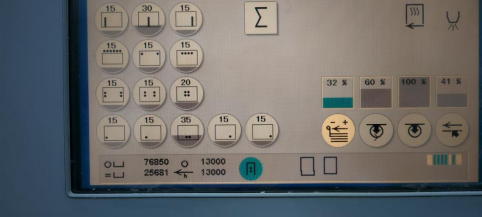
Figure 4 Adjusting the recovery machine speed