


Getting rid of 'tweaking machines by experience': How can cigarette packaging printers use AI technology to solve color management challenges?
Research background and color printing of Qujing Fupai
Production management pain points
01/ Industry characteristics of high-precision color control
Cigarette pack printing has high requirements for consistency of packaging appearance colors, accuracy of spot color reproduction, and batch stability. In actual production, enterprises usually quantitatively control indicators such as CIE L*a*b* value, spectral reflectance, and color difference ΔE*ab based on product technical standards, customer quality requirements, and physical standard samples, and monitor the process through spectroscopic color measurement and standard sample comparison. Specific color difference control limits corresponding to different products, printing materials, and printing processes should be based on the corresponding product technical requirements, industry standards (such as YC/T 330-2014 "Cigarette Strips and Packaging Paper Printing"), and enterprise internal control standards. GB/T 17934.2-2021 "Printing Technology-Process Control of Mesh Color Separation Plates, Samples, and Printed Materials Part 2: Offset Printing" specifies process control requirements for stages such as color separation, sampling, plate making, first sample signing, and printing production in offset printing. It is suitable for printing packaging paperboard materials and serves as an important technical basis for standardization and parametric control of the printing process.
The cigarette pack printing production process features multiple processes, multiple materials, and multi-variable coupling, often involving gravure printing, offset printing, screen printing, as well as subsequent steps such as hot stamping, punching, lamination, and die-cutting. Color expression is jointly influenced by multiple factors such as substrate materials, ink condition, equipment operating parameters, and environmental conditions. GB/T 18722-2002 "Printing Technology: Application of Reflection Density Measurement and Chromicity Measurement in Printing Process Control" specifies relevant applications from the perspective of reflection density measurement and chromicity measurement, providing a fundamental basis for color data collection and evaluation in the printing process.
During high-speed continuous production, the quantification, whiteness, surface smoothness, and absorbency of substrates such as transfer paper and composite card paper may vary by batch; Ink viscosity, color concentration, and solvent evaporation status can change with the production process; Fluctuations in printing machine speed, oven temperature, substrate tension, and workshop temperature and humidity can also cause changes in ink film transfer status and final color performance. Therefore, cigarette pack color management needs to shift from a single "result verification" to a closed-loop management of "process data collection - state analysis - parameter adjustment - result feedback."
02/ Analysis of the pain points of traditional color management models
Before promoting intelligent transformation, Qujing Fupai Color Printing Co., Ltd. (hereinafter referred to as "Qujing Fupai Color Printing") mainly relied on the operational experience of experienced technicians in color control and machine adjustment. Technical personnel conduct machine adjustment and correction through visual color comparison, equipment status assessment, ink status assessment, and historical experience. This experience-driven model offers strong flexibility in production practice, but as product complexity and data volume increases, the following problems gradually emerge.
(1) High test machine losses, resulting in high control costs
During the startup and test printing stage, technicians need to repeatedly stop the machine to fine-tune ink viscosity, oven temperature, and impression roll pressure. Due to the lack of quantitative parameters, test printing during machine preparation is costly and time-consuming. High-end cigarette packs use high-end positioning photolithography paper and other raw materials, which are expensive. Testing and color difference drift easily lead to high defect loss rates and cost waste.
(2) Implicit experience is highly dependent on individuals, and there is a gap in knowledge transmission
Core machine adjustment techniques and process parameters for handling complex working conditions are mainly accumulated in the personal experience of a few senior technicians, representing typical "tacit knowledge." This not only increases the difficulty of controlling product quality consistency across different machines and teams, but also requires a longer "apprenticeship" cycle to train an independent operator, and also considers the willingness of technical staff to mentor, thus facing challenges in core technology inheritance and talent pipeline building.
(3) There is a lag in quality feedback and correction
Traditional quality inspection mostly uses timed spot checks or offline spectrophotometers. Due to time lag in testing, when color differences exceed standards during offline inspection, high-speed printers have already produced many defective sheets. Additionally, manual correction based on experience can sometimes result in "insufficient fine-tuning" or "excessive fine-tuning," causing color oscillation at the edge of tolerance zones and resulting in repeated adjustments and waste.
Therefore, enterprise intelligent upgrading is not simply about replacing manual labor with AI, but about using data as a carrier to gradually transform the experience of senior technicians into recordable, analyticable, and reusable process knowledge, providing quantitative support for on-site machine adjustment while retaining human judgment capabilities.
AI color management system
Layered construction and implementation path
When advancing the AI color management project, Qujing Fupai Color Printing adheres to the principle of "technology does not leave the field, algorithms serve production," referencing the intelligent implementation strategies of typical packaging and printing enterprises, and advancing according to the hierarchical steps of "established foundation, pilot projects under construction, and long-term planning," forming a progressive path of "data accumulation - parameter recommendation - human-machine collaboration - continuous optimization."
01/ Established Foundation-Historical Data Compilation and Explicitization of Implicit Experience
Data forms the foundation for subsequent model training and process analysis. Qujing Fupai Color Printing organizes relevant technical and production personnel to organize and clean past orders, process cards, equipment operation records, and color inspection records. So far, over 1,000 raw material batch data entries, more than 30,000 equipment operation parameters, and more than 1,500 typical machine adjustment cases have been collected and integrated. These data constitute the foundational data resources for Qujing Fupai Color Printing to carry out color management digitalization and AI-assisted decision-making. Figure 1 shows the Qujing Fupai Smart Management Platform.
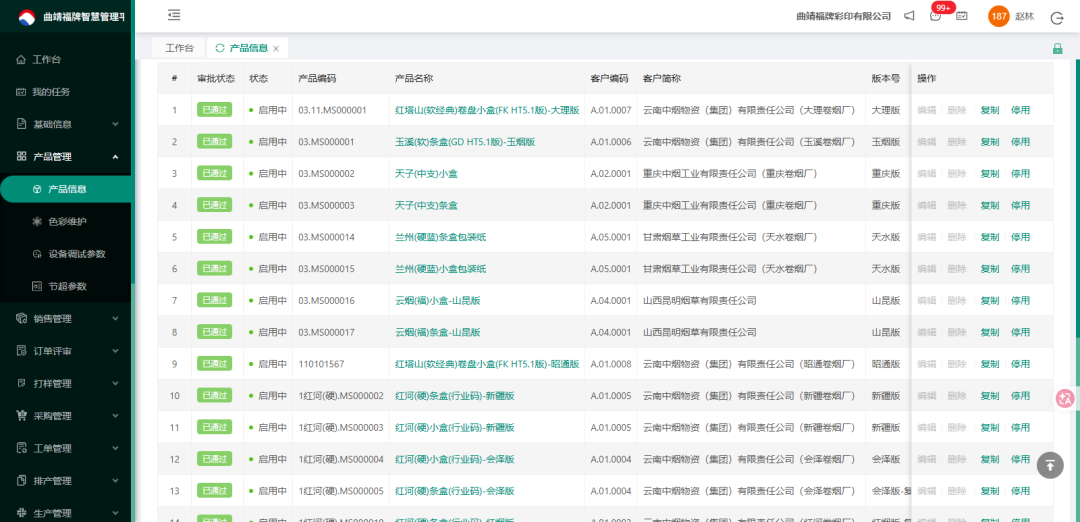 Figure 1: Qujing Fupai Smart Management Platform
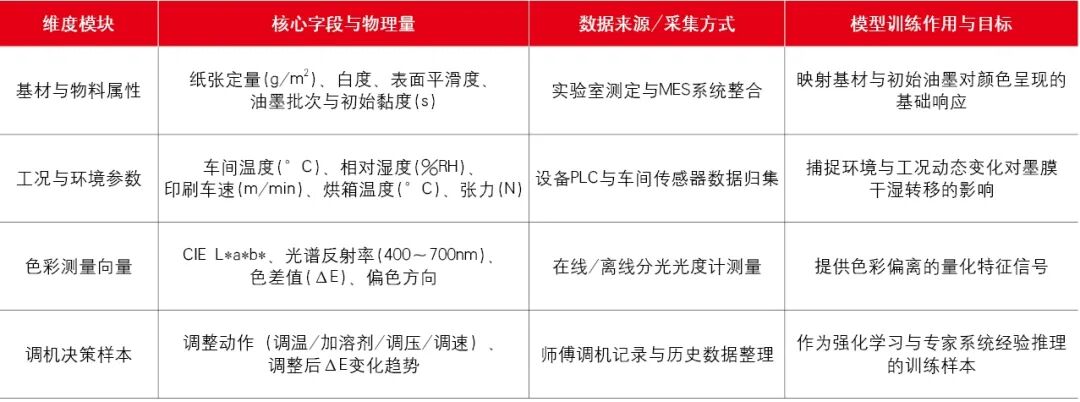
To improve the computability of historical experience, Qujing Fupai color printing is structured annotation around four dimensions: substrate and material, working conditions and environment, color measurement, and machine adjustment decisions (see Table 1), focusing on recording the process relationships of "what operating conditions - what color deviations occur - what measures taken - what results after adjustment" are recorded.
Table 1 Multidimensional Structured Annotation Dimensions of the Color Management Dataset
02/ Pilot under construction-AI real-time reasoning recommendation and industrial control linkage testing
Currently, Qujing Fupai color printing is piloting the integration testing of AI color recommendation algorithms with industrial control systems (PLCs) and online spectrometer-color measurement equipment. The system operates according to a closed-loop logic of "testing-analysis-recommendation-manual confirmation-execution-feedback," which can be broken down into the following four stages.
(1) Online color monitoring
During production, the online spectrophotometric and color measurement equipment periodically scans the designated color blocks to generate spectral and color difference data.
(2) Abnormality identification and recommendation
When color difference exceeds the enterprise's preset warning threshold or shows a persistent drift trend, the system generates auxiliary adjustment recommendations based on color prediction and formula optimization algorithms, combined with current parameters such as temperature and humidity, vehicle speed, and materials.
(3) Manual review and command issuance
Commissioners review recommended parameters on the HMI interface, and after confirmation, issue instructions to the PLC or related actuators, avoiding closed-loop control without manual review during the pilot phase.
(4) Online color monitoring feedback
Using online spectrophotometric and color measurement equipment, the printed sheet color blocks are regularly scanned and transmitted to compare chromatic aberration spectral data with standard chromaticity spectral values. Based on the data differences, AI calculates and adjusts direction and degree in real time, sends instructions to the PLC to drive the ink adjustment mechanism, making the chromaticity spectral data values infinitely close to the standard chromaticity spectral data, thereby achieving closed-loop control.
03/ Long-term Planning-Human-Machine Collaboration and Continuous Model Optimization
Given the complex conditions for cigarette pack printing and the heavy reliance on on-site experience during production, the current system is positioned as "decision assistance," designed based on human-machine collaboration theories in intelligent manufacturing, rather than completely replacing on-site technical personnel. This positioning not only helps reduce the initial implementation risks of intelligent projects, but also facilitates the continuous absorption of on-site personnel's professional experience. The corresponding human-machine collaboration mechanism includes the following four aspects.
(1) Decisions can be explained
Recommended parameters also display similar historical cases and main influencing factors, making it easier for technical staff to understand the basis for recommendations.
(2) Manual intervention is traceable
Record recommendation values, manually modified values, and actual results after modification to form a complete decision chain.
(3) Continuous review
Regularly compare AI recommendations with human processing results, identify model biases and data blind spots, and update datasets and rules.
(4) Knowledge feedback
Effective human interventions verified on site are re-incorporated into the case database, gradually forming a cycle of "personnel experience empowering machines, machine assisting personnel."
Given the complexity of cigarette pack printing and sample accumulation cycles, the current system adopts a composite technical route of "case reasoning + parameter prediction + expert rules." This approach can effectively reduce the risks of early deployment and continuously accumulate "state-action-result" feedback data in practical applications. Once the data loop stabilizes and the required training conditions are met, the system will further introduce reinforcement learning mechanisms to evolve from "assisted rule decision-making" to "autonomous adaptive optimization."
Pilot calculations and analysis of lean cost reduction effects
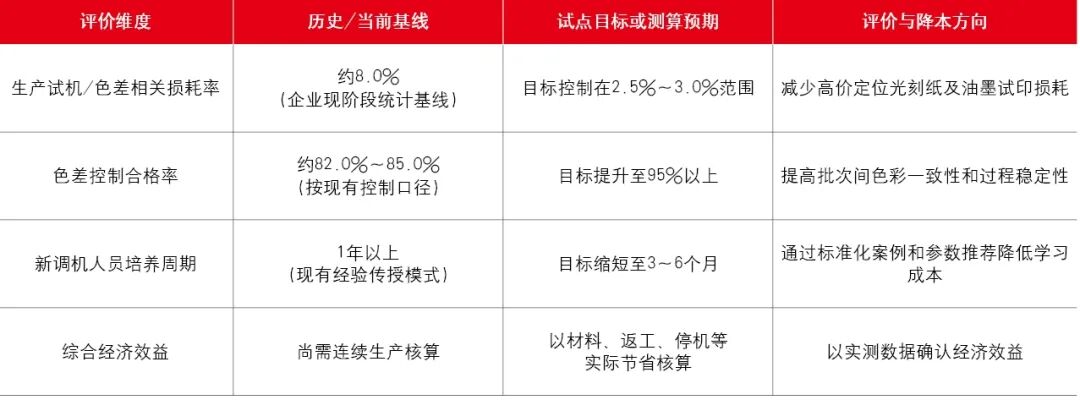
Combining pilot data from Qujing Fupai color printing local machines and comprehensive production line simulation calculations, the project shows potential in color control stability, machine adjustment efficiency, and process knowledge accumulation. In Table 2, "approximately 8.0%" and "82.0%~85.0%" are current enterprise statistics/baseline data; "2.5%~3.0%", "above 95%", "3~6 months" are pilot targets or estimated estimates, and should not be expressed as actual results for the entire line; subsequent verification should be conducted through continuous production data.
Table 2 Pilot Calculations and Expected Cost Reduction Benefit Evaluation
01/ Color control and tuning efficiency
By establishing a historical case database and online color measurement data, on-site personnel can gradually shift from relying solely on personal experience to "data-assisted judgment." After an anomaly occurs, the system can prioritize retrieving historical cases under similar materials, environments, and equipment conditions, and provide parameter adjustment directions to reduce repeated trial and error. For color drift issues, its value lies not only in reducing the time required for single machine setup, but also in improving decision-making consistency among different teams and personnel when handling similar issues.
02/ Material Loss and Lean Cost Reduction
High-grade paper, transfer paper, and spot color inks used in cigarette pack printing are of high value, and losses from trial runs and abnormal correction have direct cost impacts. Therefore, the main path to reduce project costs is not simply to reduce material usage, but to reduce material consumption per qualified product by identifying abnormal trends in advance, shortening machine setup decision time, reducing repeated trial printing, and lowering the probability of rework.
Comprehensive economic efficiency is recommended to be calculated using methods such as "reduced trial print quantity× unit material cost + reduced rework volume× unit rework cost + reduced abnormal downtime × unit equipment time cost." This paper focuses on establishing the above economic benefit evaluation framework. Specific quantitative benefit indicators will be unified after long-term continuous production validation and sufficient data accumulation are completed.
03/ Assetization of tacit knowledge and talent cultivation
The deeper value of the project lies in transforming process knowledge previously scattered within personnel experience into data resources that the enterprise can retain and continuously update over the long term. Once "operating conditions-issues-actions-results" form structured records, new employees can learn through standard cases, and technicians can quickly identify similar issues through historical cases, thereby reducing the company's single-point reliance on a few key personnel.
AI technology is being applied as an extension throughout the entire cigarette pack printing process
Based on the AI color management pilot, the company plans to further extend the digital chain to prepress, printing, back-end, and customer terminals. This part is a future development direction and must be strictly distinguished from the established data foundation and the current pilot.
01/ Prepress Document Review and Intelligent Pre-Preparation
The plan uses historical MES data to analyze paper specifications, layout ink distribution, and post-processing characteristics, gradually forming auxiliary recommendations for imposition, bite, and initial parameters. The goal is to reduce repeated judgments during the production preparation phase and provide more stable initial conditions for subsequent printing color control.
02/ Multi-defect visual inspection during the production process
It is planned to explore machine vision-based appearance defect detection in printing and post-production processes, identifying and warning of common defects such as paste pasting, scratches, inaccurate registration, and missed prints. Existing printing defect detection studies have shown that automatic detection based on image processing, feature extraction, and various classification algorithms (such as support vector machines) has application value in improving inspection efficiency and consistency, providing technical references for enterprises conducting online quality inspections.
03/ Customer terminal quality collaboration
In the long term, it can explore collecting adaptability and quality evaluation data for high-speed packaging machines in cigarette factories, linking it with internal orders, prepress, printing, and post-process data, gradually forming a closed data loop from orders to end-user feedback, and providing data support for process optimization such as hot stamping, die-cutting, indentation, and surface treatment.
Conclusion and Outlook
Qujing Fupai Color Printing uses cigarette pack printing color management as an entry point, focusing on "making tacit experiences explicit" for data organization and intelligent upgrades, forming an implementation approach of "data accumulation - parameter recommendation - human-machine collaboration - continuous optimization." Currently, the company has completed the collection and integration of over 1,000 raw material batch data, more than 30,000 equipment operating parameters, and more than 1,500 sets of typical machine adjustment cases, and has conducted pilot validations focusing on AI color recommendation, online color measurement, and industrial control linkage.
From the practical experience of Qujing Fupai color printing, the reasonable positioning of AI in tobacco packaging printing is not simply to replace on-site technicians, but to reduce repeated trial and error, promote experience sharing, and process knowledge accumulation through data collection, case retrieval, and parameter recommendations. Pilot goals and simulation results show that the project has the potential to improve color control stability, shorten machine setup decision time, and reduce trial print losses, but related economic benefits and quality indicators still need further validation through longer cycles, more orders, and more standardized control data.
In the next phase, Qujing Fupai Color Printing will continue to improve color data standards, model evaluation indicators, and human-machine collaboration mechanisms, gradually expand the pilot scope, and explore extending AI capabilities to prepress intelligent presetting, machine vision defect detection, and customer terminal quality feedback. Through a progressive path of "data-driven first, then model-based, and then intelligent," it will promote the transformation of cigarette pack printing process experience from personal knowledge into enterprise knowledge assets, providing ongoing support for enterprises to improve quality, increase efficiency, reduce costs, and cultivate talent.