


Comprehensive Guide to Alcohol Packaging Boxes
Paper molded packaging boxes are formed by bonding surface materials with molded substrates to create various components, which are then assembled into multi-component boxes. Currently, the materials used for paper molded packaging boxes are becoming increasingly diversified and complex. Surface materials are mostly paper, plastic, fabric, leather, etc., while the molded substrates are mostly cardboard, medium-density fiberboard, plastic, tinplate, and other materials.
Because these types of packaging boxes use a wide range of materials, have long production processes, many parts, and complex structures, they are mainly manually produced. However, with a significant increase in market demand, improvements in industrial manufacturing and automation, and increasingly fierce market competition, the box structures for these types of packaging boxes have become basically standardized. For mainstream box types such as top-opening bucket boxes, two-piece rigid boxes, book-style boxes, and drawer boxes, fully automated production lines have now been realized.
As shown in Figure 1, a top-opening bucket box refers to a vertical square box that opens from the top, with a vertical box body equipped with an attached flip cover. As shown in Figure 2, a two-piece rigid box consists of two individual boxes that are not sealed together, with the top and bottom boxes fitting together to close the packaging box; the top box is the 'lid,' and the bottom box is the 'base.' As shown in Figure 3, a book-style box is a packaging box that opens like a book from right to left. It generally consists of two parts: the outer shell and the inner box. The outer shell wraps around the inner box, and a part of the outer shell can be flipped open, serving as the box lid.
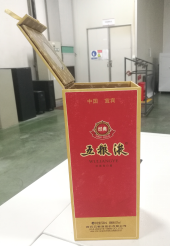
Figure 1 Opening the barrel-type box

Figure 2 Heaven and Earth Box
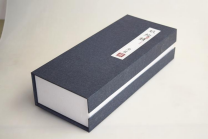
Figure 3 Book-style Box
Regarding the three common box types mentioned above, there are many equipment manufacturers in Wenzhou, Zhejiang, and Dongguan, Guangdong, that produce and develop related automation equipment. Some only manufacture auxiliary equipment for production lines, such as blister machines and edge folding machines; some produce corresponding automation equipment for specific components, such as leather casing machines, cover assembly machines, barrel-shaped box body forming machines, and two-piece box forming machines; a few companies have developed fully automated production lines for a single box type, which automates the forming of each component, automated connection of forming workstations, and automated assembly of components including box bodies, lids, shockproof pads, and bags, but they do not have the capability to manufacture automated lines for multiple box types.
Overall, the development of automated production lines for this type of packaging box is still lacking. Compared with traditional printing and packaging machinery such as printing presses, hot stamping machines, and die-cutting machines, there are still significant gaps in speed, precision, stability, and overall machine quality, and the future work is still long and challenging. Based on a survey of liquor products displayed on supermarket shelves, analysis of the structure of existing mainstream liquor forming packaging boxes, communications with multiple liquor forming packaging box manufacturers and die template manufacturers, and visits to manufacturers of automation equipment for this type of product, the author summarizes the key points of the structure of liquor forming packaging boxes to help new industry entrants efficiently select equipment, develop new products, and achieve rapid and stable mass production.
Overall Appearance
01 Opening Direction
The commonly used top-opening barrel-type boxes and book-style boxes are opened by lifting the lid from right to left, with the opening generally located on the right side. However, in recent years, there has been a noticeable trend of opening the lid from the front to the back.
Two-piece boxes are mainly divided into top-opening and bottom-opening types, and the interior products remain in the base after opening. If the box type has a vertical dimension ratio, taller single boxes can have the paper surface and core material structure designed according to the barrel-type box forming method.
02 Seam Position
The display side is the front, and the position of the center seam is generally on the side or near the back, either the left or right side. After forming, the seam edge must not be on the main display surface.
Die-Cutting Direction
Paperboard surfaces are usually die-cut on the front, while plastic-laminated paper and leather surfaces are die-cut on the back. Additionally, for a very small number of products with high contour consistency requirements, the crease on the colored surface is a V-groove on the back.
Face Paper Structure of Automatic Forming Machines
The most common forming machine production line in the industry uses the paper feed direction as the reference. The bottom of the face paper is on the right, and the seam edge is at the front as the forward direction. Forward feeding is the standard machine type. Forming on the standard machine occurs on the left in the paper feed direction. Of course, there are a few boxes with irregular mouth shapes or differentiated layout requirements that require the forming machine to feed in reverse, meaning the seam edge is at the last panel.
The bottom face paper can be connected to the box body or not, and a large seam edge can still be formed. During forming, glue is applied to the back of the face paper, and the board material aligns with one panel beyond the seam edge. The back of the face paper adheres to the back of the board, with a schematic diagram of alignment and forming shown in Figure 4.
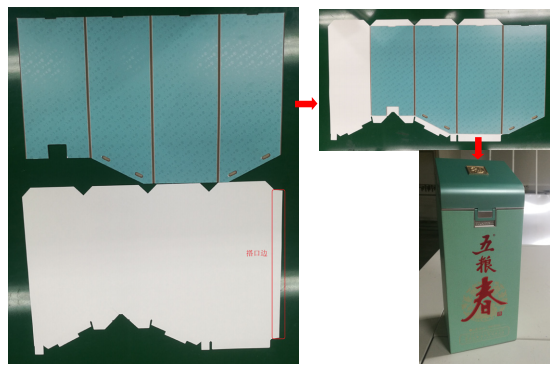
Fig. 4 Schematic diagram of alignment molding
Color surface matching size
01
The hole diameter is matched
After the color surface and the plate hole are centered and aligned, the diameter of the color surface is 4mm outer and 5mm inside, and the cardboard hole is the same as the inner hole diameter of the color surface. The size of the inner and outer holes of the color surface is the same as that of the industrial cardboard 6mm.
02
Double indentation line
The double indentation width is increased by 0.3mm according to the thickness of the plate.
03
Mouth edge design
The mouth edge is divided into three types: mouth gap, middle seam gap, and bottom mouth, and the width of the mouth edge is 15~20mm. The die-cut line on the edge of the mouth and bottom is 0.5mm closest to the mouth and bottom indentation line.
The slope of the mouth edge of the mouth is 90°, and the die-cut line of the mouth of the book-shaped box intersects with the indentation line, and the slope of the mouth edge is 45°. The slope of the middle seam is 10~15°. The slope of the bottom lap is 90°.
04
Color side dimensions
The side size of the middle seam is equal to the size of the other side minus 0.5~1mm.
Industrial cardboard
01
Cardboard shrinks size more than tissue paper
Tissue paper that is easy to absorb water and has a significantly larger size refers to the material that has not been sealed on the back, generally refers to 105~125g low-gram weight paper. Cardboard surface width = corresponding tissue paper width - 0.3mm, cardboard height = corresponding tissue paper width - 1mm.
Tissue paper with medium size increase after water absorption refers to the material with a sealing layer on the back, which is generally used for 150~190g special paper and white cardboard. Cardboard surface width = corresponding tissue paper width -0.5mm, cardboard height = corresponding tissue paper width -1mm.
Tissue paper with a small increase in size after water absorption refers to the material with a water sealing layer on the back, generally refers to 255~375g gold and silver cardboard, high weight special paper. Cardboard surface width = corresponding tissue width -0.7mm, cardboard height = corresponding tissue width -1mm.
However, the side width of the industrial cardboard seam does not take into account the reduction size and should be consistent with the side width of the other side. After finding the root cause of the problem, we made corresponding technical requirements for replacing the embossing rubber roller, first, it is required to measure the diameter error of both ends before replacing the imprint adhesive roller, and the error exceeds 0.5mm is prohibited from being used on the machine, and the imprint adhesive roller needs to be re-grinded, and the large and small head marks should be made; second, avoid the size of the imprint adhesive roller of two adjacent units facing the same side. Through the above measures, the problem of inaccurate overprinting caused by the different diameters of the two ends of the imprinting rubber roller is basically eliminated.
02
Cardboard matching method
There are generally two ways to collide between the middle seams of the cardboard of the box, the concave and convex buckles are matched and the 45° beveled edge is open. There are generally two ways to collide with the bottom of the cardboard and the bottom plate, namely the concave and convex buckles and the right-angled edges.
After long-term verification, whether it is an automatic forming machine or traditional manual operation, the structure of the concave and convex buckle matching method is more stable and stable, and the probability of high and low angles is lower. Concave and convex buckle depth = cardboard thickness -0.1mm, with a difference of 1mm between the width of the concave and convex positions; The groove buckle at the bottom of the box is designed with a width of 20~35mm; The midseam concave and convex buckle is designed according to the distance between the two ends in five equal parts of 20mm.
03
Tooth knife line
The box cover industrial cardboard that needs to be bonded with blister pads and ribbons can be designed with tooth knives for positioning. The position where the cardboard needs to be torn should be designed with a tooth knife line to reduce the burr after tearing.
04
Tooth knife line
The width of the slogan is 18~25mm, usually 20mm. The back of the barrel box mouth is half pierced with a knife, and 1/3 is left uncut according to the thickness of the cardboard.
05
Slotting requirements
The grooving angle should be clear on the knife mold drawing, and the grooving angle of various products in the existing process is shown in Table 1.
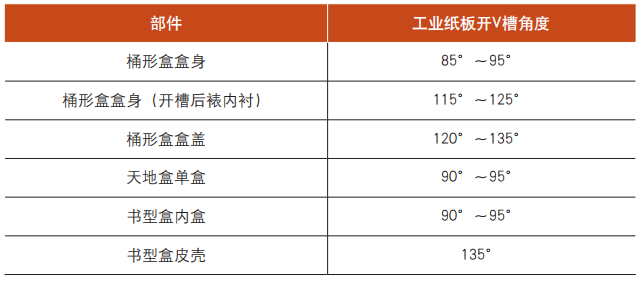
Table 1 Slitting Angles of Industrial Paperboard
Imposition Considerations
The standard paper sizes in the industry are 787×1092mm for full sheets and 889×1194mm for large sheets, with roll widths of 787mm and 889mm. Typically, the first dimension of the paper is the width, and the second dimension is the length, i.e., the fiber direction.
When arranging the imposition, try to align the paper width with the standard sizes of 787mm or 889mm to save paper. Paper manufacturers are not likely to change this width unless the order quantity reaches several hundred tons. The feasibility of customizing the paper length is relatively high.
01
Box Body Imposition
When imposing multiple box bodies, align head-to-head or head-to-tail, with the center sheet symmetrical in the middle when three sheets are used, and try to align the slitting positions in the three-sheet setup.
02
Box Lid Imposition
For box lids, join the tails of the industrial paperboard in a two-sheet connection, connect with a central die or dotted connection, and then proceed with multi-sheet imposition.
03
Interleaf Paper Imposition
For low grammage interleaf paper with a high length-to-width ratio in a single sheet, when imposing multiple sheets, ensure the long side of the single sheet is vertical to the paper length, with the long side parallel to the paper width. Typically, the first dimension of a single sheet is horizontal to the grain.
04
Connection Points
Connect between sheets using dotted points, with a width of 0.8mm, to facilitate die-cutting production. Place the points on the V-groove line or on both sides of the embossing, avoiding grooves, openings, or visible areas.
Through research, analysis, and production practice over the past two years, the company has established several production lines including automatic forming lines for open-top boxes, telescopic boxes, book-style boxes, and traditional manual assembly lines. The process technology and operators all come from the previous ordinary folding box industry. Production capacity has grown from zero to now reaching 80,000 units/day.
Whether the structure is simple or complex, and regardless of changes in the surface paper or the substrate, it can be applied according to the above common principles. As long as the matching of dimensions is clear - external component inner dimensions to internal component outer dimensions, considering material thickness, uncompressed thickness, and uncut thickness - new projects can reduce production hurdles and quickly enter mass production.