


Canon × Jiexun Jiacai explore a new model for publishing and printing transformation, and the industry's first Canon VarioPRINT IX3200 is here!
On September 8, 2026, the Canon varioPRINT iX3200 Jiexun Jiacai on-site visit and special seminar for the printing industry, themed 'Digital Intelligence and Ink Presents New Chapters of Book Fragrance: Exploring Changes in High-End Color Printing,' was successfully held in Beijing. This event was organized by Canon (China) Co., Ltd. together with the Beijing Printing Association and Beijing Jiexun Jiacai Printing Co., Ltd. (hereinafter "Jiexun Jiacai"). It not only showcased the results of the collaboration between Canon's high-end inkjet equipment and Jiexun Jiacai's deepened strategy but also provided a platform for local publishing and printing companies to benchmark in real scenarios and exchange experiences, serving as an important demonstration for the print-on-demand transformation in the national publishing and printing industry. During the event, reporters had the opportunity to interview Mr. Ji Shaohua, General Manager of Beijing Jiexun Jiacai Printing Co., Ltd., and Mr. Toshihiko Nagamatsu, Senior General Manager of Canon (China) Co., Ltd.'s Digital Printing Division and Commercial & Industrial Printing Division, to decode the transformation logic and practical examples of the publishing and printing industry from various perspectives including policy, industry, and technology.

Canon (China) Co., Ltd.
Toshihiko Nagamatsu, Senior General Manager of the Digital Printing Headquarters, Business and Industrial Printing Division
 Beijing Jiexun Jiacai Printing Co., Ltd
Industry transformation
On-demand printing has changed from "multiple-choice" to "mandatory questions"
When discussing the current development situation of the publishing and printing market, a set of industry data became a consensus among the guests present. According to data released by the National Press and Publication Administration, by 2025, the proportion of printing output value in China's publication printing to total printing output has dropped from 13.8% in 2021 to 8.9%, with traditional large-volume printing demand continuing to shrink; at the same time, there are now 7,423 digital printing enterprises nationwide, a year-on-year increase of 23%. The rise and fall reflect that market demand is rapidly shifting from "large batches and standardization" to "small batches, multiple varieties, fast delivery."
According to Zhang Yi, Chairman of the Beijing Printing Association, the publishing and printing industry is currently in a critical window of overlapping policy support and technological transformation. 2026 marks the start of the 15th Five-Year Plan, and new-generation information technologies such as artificial intelligence, big data, and the Internet of Things are accelerating integration with the entire printing industry chain, promoting the industry's transformation from traditional processing and manufacturing to intelligent manufacturing, on-demand printing, and personalized customization. In 2025, the National Press and Publication Administration issued the "Three-Year Action Plan for Printing Industry Digitalization (2025–2027)," clearly proposing to promote the construction of a digital empowerment system for the printing industry. As an important application scenario for digital printing, on-demand printing has entered a more defined policy development path.
"In the past, digital printing was more of an auxiliary requirement for traditional printing by publishers, but now on-demand printing is no longer a 'choice' for enterprise development; it is becoming a 'must-have' for the digital transformation of the publishing and printing industry." Chairman Zhang mentioned that the industry has long faced the common challenges of "increasing product variety, declining print volume per product, and high inventory." With the flexible model of "starting from one book, each book different, selling first, printing later," on-demand printing can effectively reduce inventory and inefficient production, enhancing publishing companies' responsiveness to market changes.
Moreover, from the perspective of frontline practice by publishers, print-on-demand printing has become a core lever for reducing inventory and improving efficiency. In many leading publishers, digital printing now accounts for more than half of the print runs, with two-color and four-color digital printing maintaining double-digit growth, and demand for diverse binding formats such as hardcover and loose-leaf binding has surged. However, during the transformation process, the industry still faces many common pain points: for example, insufficient production capacity during peak periods for textbooks and forced extended production cycles; Exquisite sample production but disconnect in mass product quality, easily triggering reader complaints; Difficulty controlling color consistency in book sets, and issues like ruffled edges and cover bulge in thread binding; Risks to the security of printed documents and managing version accuracy; Back-end process support cannot keep up with the fast pace of on-demand production, restricting the upgrade of on-demand printing from "supplementing capacity" to "mainstream production models."
Targeting these common industry pain points and upgrade needs, the Canon varioPRINT iX3200 sheet-fed inkjet printer (hereinafter referred to as "Canon iX3200") is implemented in Jiexunjiacai with its core advantages of "high quality, high productivity, high intelligence, low consumption and environmental protection," providing a practical technical solution for the on-demand printing transformation of the publishing and printing industry.
Rising against the current
Jiexunjiacai has created a benchmark model for dual-track production
As one of the pilot units for digital development and reform in Beijing's printing industry, Jiexunjiacai introduced the Canon iX3200 and achieved mass production, which is regarded within the industry as a benchmark case for on-demand printing. Facing the question of "why does Jiexunjiacai persist in large-scale investments even during the industry's downturn?", Mr. Ji admitted that Jiexunjiacai has been deeply involved in the printing industry for nearly 40 years, and this decision was not made impulsively but based on a long-term judgment of market trends.
"The overall environment of the printing market is shrinking and declining, but there are still some markets that need high-quality, stable output equipment." Mr. Ji mentioned that currently, the industry has an overcapacity at low-end ends, and companies are engaging in price wars on low-value products; But supply in the mid-to-high-end market is insufficient, and publishers are always looking for partners who can meet quality expectations. "We don't put profit first, but a sense of responsibility and a lifelong commitment to printing come first."
In Mr. Ji's view, introducing the Canon iX3200 is an inevitable choice to address the company's capability shortcomings. Jiexunjiacai entered the digital printing track in 2018, starting with toner machines and gradually deepening its presence in the short-run printing market. Along the way, it has encountered pitfalls in equipment selection, with the core pain point being the difficulty of finding a mid-to-high-end production solution that is "reasonably priced, cost-controllable, and ensures high-quality output." The Canon iX3200 perfectly matches the company's development pace, with appropriate equipment cost, small footprint, and flexible operation, making it very suitable for the production scenario of mid-to-short premium books.
Since introducing the Canon varioPRINT iX3200 sheet-fed inkjet printer, Jiexun Jiacai has proven the practical value of the equipment in three major areas:
01
Flexible capacity
This Canon iX3200 officially entered production in June 2026, currently maintaining a monthly print run of 1 million (A3), mainly used for publication printing; Duplex printing speed reaches 320 A4 pages per minute, with a monthly capacity covering 1 million to 10 million (A4), flexibly meeting different needs from sample books to bulk orders.
02
Excellent quality performance
The device features 1200dpi ×1200dpi high resolution, combined with Canon's on-demand piezoelectric inkjet and multi-level ink drop control technology, delivering sharp text and accurate color reproduction, with quality comparable to offset printing; Supports 60~350g/m² uncoated paper and 90~350g/m² coated paper, delivering excellent output consistency across different materials.
03
Model innovation
It truly achieves "one print from one book" and instant printing, covering postcards, photo books, picture albums, magazines, and books with a single machine, creating a benchmark factory for on-demand printing that can be visited, verified, and replicated.
Regarding Jiexun Jiacai's production practice, Canon Yongsong also gave high praise: as a book and periodical printing factory, Jiexun Jiacai was the first to introduce and put the Canon iX3200 into production, creating a model "on-demand printing benchmark factory" for industry reference; This is Canon's first officially launched iX3200 in the domestic publishing industry, and its value in actual production is evident from monthly print runs and other data.
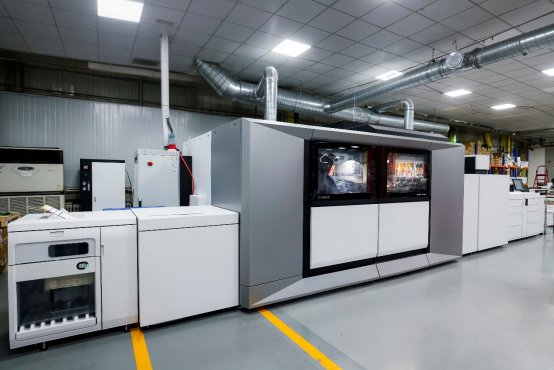 As a book and magazine printing factory, Jiexun Jiacai was the first to introduce the Canon iX3200 and put it into production.
Talking about the strategic significance of this investment, General Manager Ji summarized it in three points: First, capability upgrade – filling the gap in high-quality water-based inkjet coated paper printing to form a dual layout of offset and digital printing; second, competitive breakthrough – in the new market norm of low labor cost and high quality, winning customers with efficiency and quality; third, industry leadership – hoping to pave a referenceable path for transformation for peers in the Beijing-Tianjin-Hebei region.
"We have always walked a different path – breaking through the Red Sea, crossing the Purple Sea, and looking for the Blue Ocean," revealed General Manager Ji. He added that Jiexun Jiacai is currently negotiating the purchase of a second Canon device, aiming at the Canon ProStream series, to continue expanding mid-to-high-end digital printing capacity.
**Building Technology Foundation**
Canon anchors the on-demand printing track with high-end inkjet
The Canon iX3200 device implemented at Jiexun Jiacai is a flagship sheet-fed inkjet printer specifically designed by Canon for high-end books, boutique publications, and cultural creative printing scenarios. It is also the first device of this model to be formally put into mass production in China's publishing industry. According to General Manager Yong, the core advantages of the Canon iX3200 can be summed up as "three highs and one low": high quality, high productivity, high intelligence, and low carbon and environmental impact. The device uses on-demand piezoelectric inkjet technology and multi-level variable droplet control technology to ensure sharp text edges and rich image layers; it supports non-stop paper loading and mixed media printing, showing particularly stable and excellent color performance with coated paper, which is its important differentiating advantage. At the same time, it is equipped with a PRISMAsync controller and automated workflow, enabling intelligent management throughout the entire process from prepress, printing, to post-press.
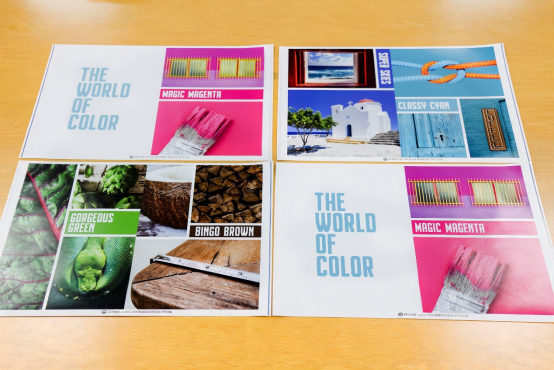
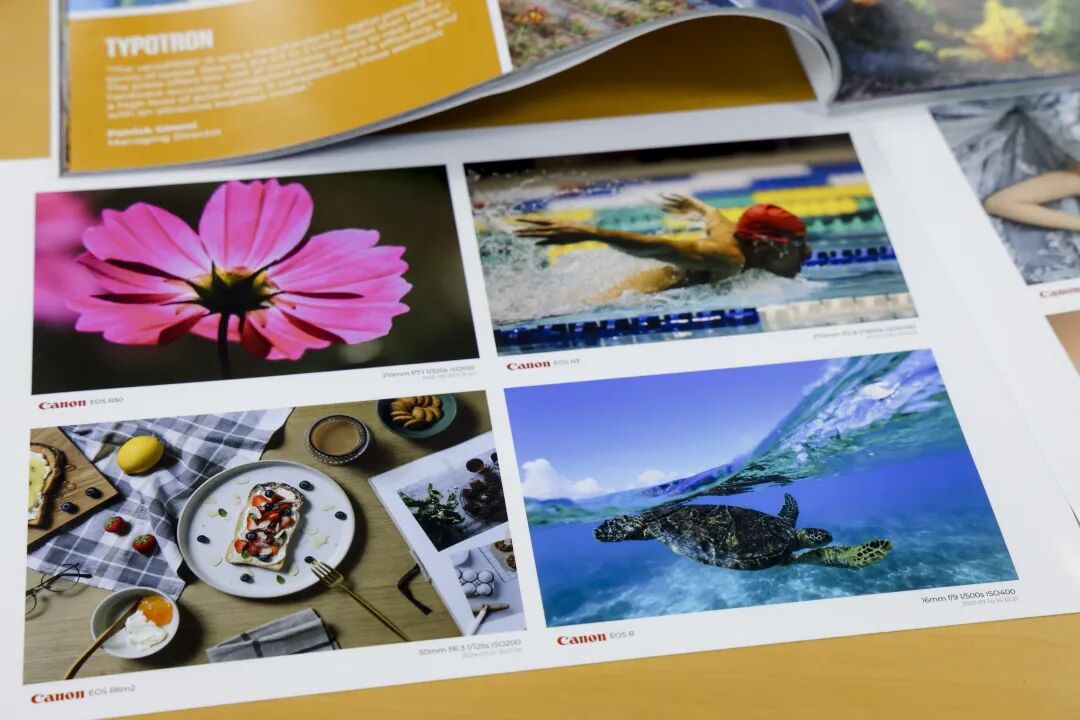 The images produced by the Canon iX3200 have rich depth and layers.
Additionally, in response to the industry's growing focus on green and low-carbon demand, the Canon iX3200 incorporates environmental protection concepts throughout the entire chain, from technical design to production models. It uses Canon's self-developed aqueous pigment inks, which are more environmentally friendly than traditional solvent inks; the device operates with zero ozone emissions, helping businesses achieve their sustainability goals; it also has excellent ink removal performance, making printed materials easier to recycle; and its on-demand production model naturally reduces overprinting and inventory buildup from the source, achieving overall resource savings.
Regarding this collaboration, Mr. Yong Song said that the actual print volume since the device went into production has exceeded one million copies. This not only proves the reliability of Canon's high-end inkjet printing technology in real production scenarios but also creates an industry chain collaboration model involving 'equipment manufacturers, printing companies, industry associations, and publishers.' It allows advanced technology to truly enter workshops, integrate into production processes and supply chains, and transform into real productivity.
In Chairman Zhang's view, Canon's role goes beyond just supplying equipment; it is also an important part of the industry's collaborative ecosystem. The Beijing Printing Association will continue to focus on three areas: building platforms, promoting collaboration, and fostering benchmarks. That includes regularly conducting digital transformation training and self-assessment to help companies understand their stage and fill capability gaps; enhancing resource integration in the Beijing-Tianjin-Hebei region to enable more direct and effective communication between publishers, printing companies, and technology providers like Canon; and using the experience of JieXun JiaCai as a model to turn proven successes into reference points for equipment selection and implementation paths for more companies.
Currently, the Chinese market is at a critical window for digital transformation, and the rapid growth in 'print on demand' requirements provides broad application opportunities for the Canon iX3200. However, the industry faces the shared challenge of helping more publishing and printing companies recognize that digital printing can now rival traditional offset printing in quality and cost, and encouraging them to take the first step toward transformation. Going forward, Canon will insist on 'In China, for China,' responding to market needs through technological innovation, offering locally tailored solutions and high-quality services, helping customers reduce costs and improve efficiency, and working with industry partners to seize this transformation opportunity.
From policy guidance to market-driven forces, from equipment upgrades to factory practices, this seminar not only showcased the benchmark results of the Canon iX3200 in action but also created a platform for in-depth dialogue among publishers, printing companies, and equipment suppliers. In the future, print-on-demand will shift from single-point breakthroughs to full-chain integration, and digital printing factories like JieXun JiaCai, along with technology providers like Canon, will work together with industry associations and publishing institutions to advance the publishing and printing industry toward intelligence, sustainability, and high quality.