


Canada's 55.7 billion packaging market is changing: plastics defend their position, flexible packaging breaks through, glass declines step by step
In 2025, the total Canadian packaging market will reach 55.7 billion units. Rigid plastics will hold the top spot with a 36.8% share, while flexible packaging will lead growth over the next five years with a 1.6% compound annual growth rate. Driven by both growing consumer environmental awareness and the implementation of EPR regulations, recyclability, lightweighting, and the circular economy are redefining this market worth tens of billions of units.
1. Market Overview: 55.7 Billion Units – Who is Leading?
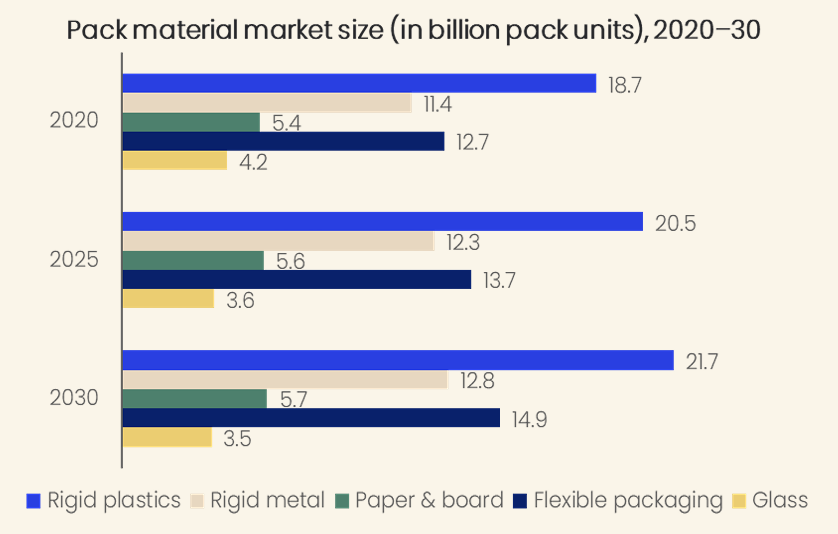
In 2025, the ranking of the five major packaging materials in the Canadian market will be set: rigid plastics (20.5 billion), flexible packaging (13.7 billion), rigid metals (12.3 billion), paper and cardboard (5.6 billion), and glass (3.6 billion) at the bottom. By 2030, the overall market size is expected to reach 58.7 billion units, with a compound annual growth rate of 1.1%.
An interesting phenomenon here is that while rigid plastics have the largest volume, they do not have the fastest growth. Flexible packaging is the true growth champion, maintaining a 1.6% compound growth rate between 2025-2030. Glass, on the other hand, contracted at a rate of -2.7% from 2020 to 2025, and although the decline slows to -0.5% from 2025-2030, the downward trend is set.
"2020-2030 Evolution of the Market Size of the Five Major Packaging Materials in Canada" – a chart to clearly see which are rising and which are falling.
2. The Food Industry is an Absolute "Packaging Money Eater"
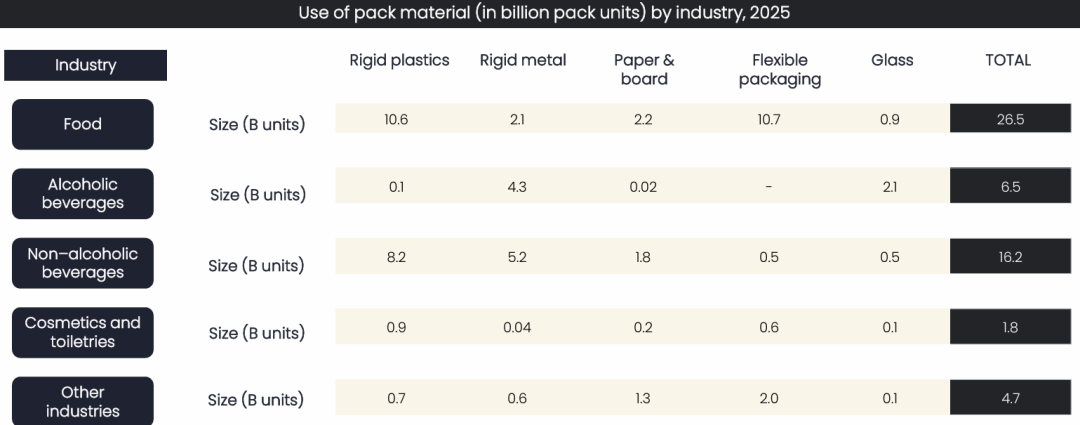
47.6% - This is the share of the food industry in Canada's total packaging consumption in 2025, equivalent to 26.5 billion units. The runner-up, non-alcoholic beverages (16.2 billion), follows closely, and together they consume three-quarters of the entire market.
How big is the appetite of the food industry? It alone consumes 10.6 billion units of rigid plastics (51.9% of that material) and 10.7 billion units of flexible packaging (77.6%). The rise of Canadian meal-kit companies like HelloFresh and GoodFood is continuously driving up the demand for corrugated cardboard.
📊 "Structure of Packaging Material Use by Industry in Canada 2025" - visually presenting the dominance of the food and beverage industry.
3. What do consumers really want?
GlobalData's Q1 2026 consumer survey provides a clear answer:
81% of Canadian consumers consider "convenience" as a must-have or a plus
71% think "recyclable" is important
71% value "sustainable/environmentally friendly" attributes
42% hope packaging has smartphone connectivity features (such as scanning to view product information)
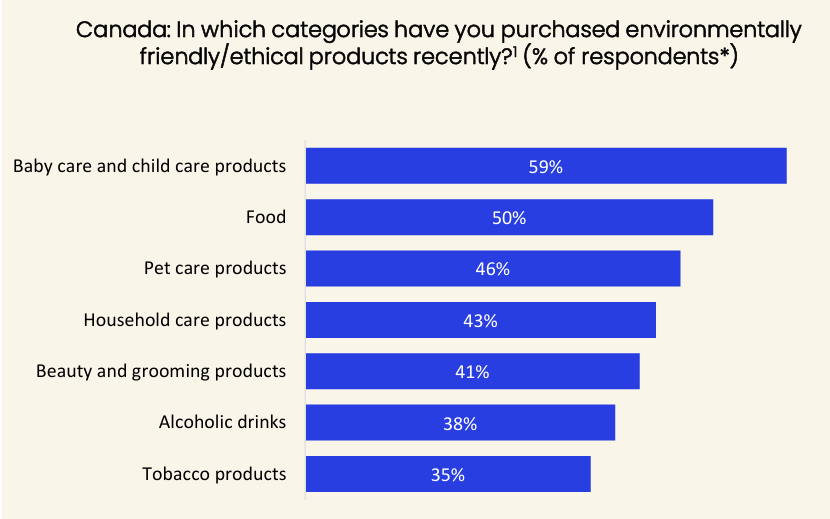
What's even more notable: 59% of consumers have recently purchased eco-friendly baby products, and 50% have purchased eco-friendly food. This means that brands' sustainability commitments are shifting from marketing rhetoric to concrete factors in purchasing decisions.
📊 "Distribution of Eco-Friendly Product Purchases by Canadian Consumers" - Baby products and food consistently top the list.
IV. The Fate of the Five Major Materials
Rigid Plastic: Still the top choice for food and non-alcoholic beverage manufacturers, with bottles being the absolute mainstay. However, emerging segments like skincare and plant-based meat will contribute the fastest growth (skincare CAGR 5.4%).
Rigid Metal: Aluminum cans continue to dominate the beverage track, with non-alcoholic beverages contributing 48.8% of future increments. But the growth rate slows from 1.5% to 0.9%, as the food industry begins to switch to cheaper plastic alternatives.
Paper and Cardboard: Growth is flat (0.5% CAGR), but the home care segment stands out-cardboard usage share is expected to rise by 5.6 percentage points, driven by a 5.5 percentage point decline in tobacco packaging share creating space.
Flexible Packaging: The fastest-growing track. Baked cereals, savory snacks, and confectionery are the food heavyweights; skincare and cosmetics categories are growing rapidly within cosmetics. Home care products are expected to become the strongest dark horse with a 3.9% CAGR.
Glass: Alcoholic beverage usage will drop by 177 million units. High costs, inefficient logistics, and consumers switching to aluminum cans form a triple blow, making recovery difficult. But the cosmetics category is a highlight, expected to grow at a 2.3% CAGR.
📊 "2025-2030 Industry-Material Combination Chart"-instantly identify high-growth opportunities.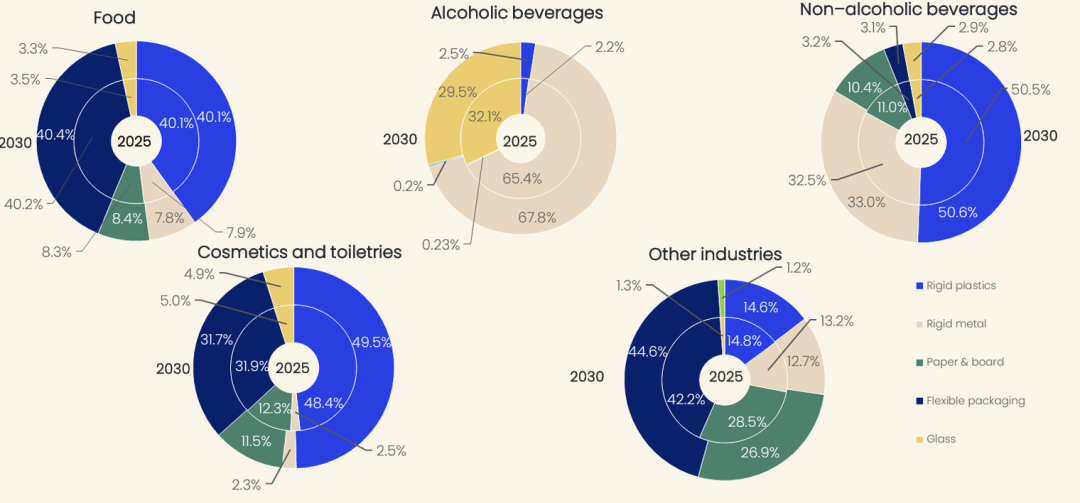
V. Regulation and Capital Are Reshaping the Game
In April 2025, Alberta officially implemented the first phase of EPR (Extended Producer Responsibility), shifting recycling costs from municipalities and taxpayers to producers. Starting January 2026, Ontario's Blue Box program will fully transition to producer responsibility - meaning all fast-moving consumer goods brands selling products in Canada will have to pay for the "afterlife" of their packaging.
Capital movements are also telling:
BASF and Sustane Technologies
Signed a long-term pyrolysis oil procurement agreement to secure recycled plastic raw materials
Axium Packaging
Built a new plastic recycling plant in Ontario to serve North American food, pharmaceutical, and medical clients
MULTIVAC Canada
Launched TX 620/T 205 tray-sealing machines supporting MAP (modified atmosphere packaging)
The circular economy is no longer just a slogan; it is a tangible industrial layout.
Canada's packaging industry is undergoing a "reshuffle of material status": rigid plastics hold the base market, flexible packaging captures new growth, and glass is steadily declining. Regulatory tightening, consumer awakening, and brand commitments intertwine - whoever takes the lead in sustainable solutions will secure the entrance ticket for the next five years.
💡 Three Key Insights
Insight 1: Growth dividends lie in "niche scenarios," not "major categories"
With a 1.1% CAGR for the overall market looking modest, niches like rigid plastics in skincare (5.4%), flexible packaging for plant-based meat (6%), and flexible packaging for household cleaning products (3.9%) show the real opportunities lie in segmented tracks.
Insight 2: EPR regulations will reshape cost structures, putting pressure on small and mid-sized brands
When producers must pay for packaging recycling, brands using hard-to-recycle composites will face increased hidden costs, while those that already use single-material, recyclable designs will gain a relative advantage.
Insight 3: Glass decline is a trend, but not a total wipeout
Switching alcoholic beverages from glass to aluminum cans has become inevitable, but in cosmetics, glass can still maintain a 2.3% growth - the sense of "premium" and "inert safety" remains irreplaceable in certain scenarios.