


Subverting Tradition! Do You Know These Technological Innovations on Anilox Rolls?
Anilox rolls are often referred to as the "heart" of flexographic printing, as they can precisely measure the amount of ink delivered to the printing plate and ultimately transferred to the substrate. Their working principle seems simple, but with the continuous evolution of packaging and label printing, there is an ongoing demand for innovation in anilox roll technology.
In today's narrow-web printing market, printing companies are expected to provide shorter print runs, higher-quality prints, and sustainable solutions while maintaining normal operating time and efficiency, making the role of anilox rolls more critical than ever before. Advances in manufacturing and engraving technology are redefining how printers view anilox rolls.
Laser Engraving Technology
One of the biggest transformations in the field of anilox roll manufacturing comes from laser engraving. Early mechanically engraved anilox rolls have long been replaced by laser-engraved ceramic-coated rolls, which offer extremely high precision. Today, suppliers are continuously pushing the limits of laser technology to engrave finer, deeper, and more uniform cells.
For example, multi-beam fiber laser systems can achieve high-definition engraving and better uniformity across the entire roll surface. This results in cleaner print quality, less dot gain, and higher repeatability. Additionally, the advancement in engraving precision has enriched the shapes of cells-elongated cells, channel patterns, or hybrid shapes. These shapes are specially designed to optimize ink transfer for specific applications, achieving the visual effects required by brands while minimizing waste through precise ink control.
XCAT Hybrid Engraving Technology
Since the early 2000s, engraving technology has shown diverse differences in various production applications. As we see in today's market, from labels and flexible packaging to corrugated packaging, no single engraved cell pattern can handle multiple applications well or solve multiple issues.
XCAT hybrid engraving technology, introduced by the American company Harper Corporation, is a new generation of engraving technology aimed at solving the problem of ink misting. It is well-known that ink misting is a common printing defect in flexographic printing, where tiny droplets of ink splash out from the anilox roll or doctor blade chamber onto the substrate, creating visible spots, stripes, or hazy effects.
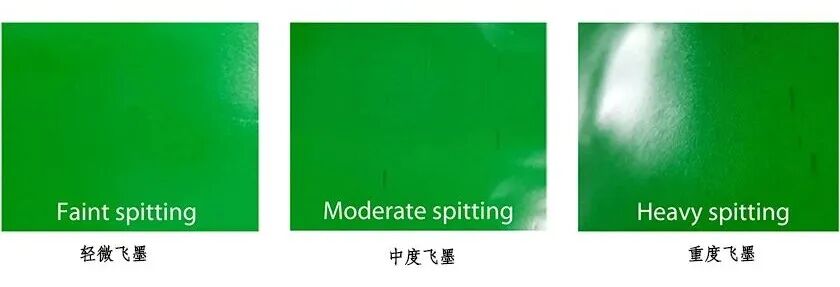
The XCAT hybrid screen engraving technology is an improvement based on the 60° hexagonal screen engraving technique. It is a hybrid screen pattern that uses 60° channels and engraving beneath the channels, which can achieve good ink transfer, and the bottom of the screen cells can better control the ink. It is suitable for all applications from large solid areas to four-color printing. For thick coatings, the XCAT hybrid screen engraving technology also improves ink transfer, and due to improved fluidity, it reduces air entrapment, meaning fewer ink bubbles.
GTT 2.0 open serpentine screen engraving technology
UV ink is different from solvent-based or water-based inks in that it has higher viscosity and is more difficult to transfer, especially when using traditional closed-screen engraving roller cells, which easily cause ink splashing. To address this problem, some printing companies have adopted temporary effective measures, such as replacing the doctor blade, adjusting printing press speed, increasing temperature, or re-polishing the engraved roller. However, these methods do not fundamentally solve the problem, and eventually, ink splashing occurs again, leading to reduced productivity and increased waste.
GTT 2.0 open serpentine screen engraving technology is a patented technology of Apex, which has revolutionarily changed the cells of the engraved roller, once again breaking through the application bottleneck of engraved rollers and laying a solid foundation for the further development of high-definition flexographic printing.
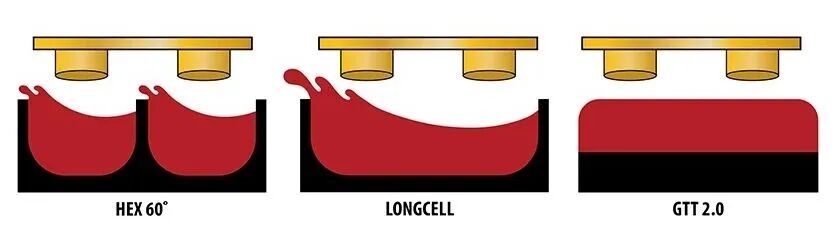
The GTT 2.0 open serpentine cell engraving technology uses a different production process from traditional gravure rollers. It employs higher-density ceramics for coating and continuous, consistent laser engraving. The biggest advantage of this technology is that it no longer traps ink in closed hexagonal cells, preventing ink accumulation at the source, improving ink flow, making four-color printing more stable, and reducing printing preparation time. It offers better printing performance, reduces the configuration of gravure rollers, provides a smoother inking performance, significantly saves ink usage while achieving the same density, reduces lateral walls of cells, increases plate durability, and allows the doctor blade to achieve good inking effects with very light pressure. Both the wear on the doctor blade and the gravure roller are greatly reduced, extending their lifespan. The open serpentine cells fundamentally alleviate the issue of ink spattering with UV inks.
Future technology direction for gravure rollers
With the gradual implementation of sustainable development concepts, gravure rollers will reduce the possibility of ink waste through precise ink delivery, reduce usage through improved durability, and rely less on strong chemicals through laser cleaning, thereby reducing the environmental impact on printing workshops... a series of technological changes are practicing environmental responsibility.
In the future, gravure roller innovation will further integrate with digital printing. As hybrid presses become more common, gravure rollers will need to coordinate with digital printing units, balancing ink transfer with digital quality standards. Advances in laser technology may allow cell structures to dynamically optimize ink release for multiple applications, further reducing inventory requirements. In addition, with increased automation, we can expect gravure rollers to be integrated into fully automated press setups, where robotic systems handle identification, installation, and cleaning. From a sustainability perspective, research into alternative materials and eco-friendly coatings could redefine durability and recyclability standards.
In summary, gravure rollers will continue to develop in sync with flexographic printing processes. As long as brand owners demand higher quality, faster delivery times, and greater sustainability, gravure roller technology will continue to innovate to meet the ever-changing needs of their label customers.