


Save over 900,000 yuan in electricity costs annually-sharing practical experience on intelligent renovation of printing process cooling water systems!
The traditional process water cooling system at the printing factory of the author's group is mainly responsible for cooling the electrical cabinets and main motors on two German Manroland COLORMAN wide-format production lines. It has been operating for nearly twenty years and faces several prominent pain points: Trane refrigeration main units and pumps operate at fixed power, resulting in severe energy waste; Large temperature control errors, condensation in summer easily occurs, affecting printing quality and equipment lifespan, and causing multiple leaks and leaks; Office and production areas rely on independent Carrier main unit systems for summer cooling, resulting in consistently high overall energy consumption.
To address this, our factory has launched a PLC-based process water cooling system upgrade, using PID control algorithms to achieve precise temperature control and intelligent energy saving, and innovatively expanding the "winter printing cooling energy-saving + summer office cooling cooling" function. After the upgrade, the system's temperature control error ≤ 0.5°C, with a comprehensive energy-saving rate as high as 30%. This not only provides solid support for cost reduction and efficiency improvement, but also offers replicable practical experience for printing enterprises upgrading green energy-saving technologies.
Current situation analysis clarifies the core needs for cooling system upgrades
During high-speed operation of printing equipment, electrical control devices such as frequency converters inside the cabinet generate a large amount of heat, directly affecting equipment lifespan and even causing equipment failures and shutdowns. This is also the core issue that the process water cooling system needs to solve.
Our factory's original process water cooling system adopts the traditional configuration of "refrigeration main unit + cooling tower + water pump," with core equipment including two water-cooled Trane main units, two cross-flow cooling towers, multiple circulation pumps, as well as standard solenoid valves, control valves, and plate heat exchangers. Cooling in office and production areas is supplied separately by a large independent centrifugal Carrier central air conditioner. After years of operational practice, this process water cooling system has revealed three major issues.
(1) Insufficient temperature control accuracy. Relying on direct cooling by central air conditioning with cold water cannot flexibly adjust the temperature according to production needs, resulting in large outlet temperature errors that make it difficult to meet the equipment's process water temperature requirements. The condensate problem around equipment is especially severe in summer.
(2) Energy consumption remains high. On one hand, central air conditioning for printing cooling runs at full capacity year-round, while the supporting pumps and fans lack intelligent speed regulation mechanisms, maintaining fixed power regardless of production load, resulting in severe energy waste; On the other hand, office area cooling relies on the original independent Carrier air conditioning units in the factory. Later, as the factory scale shrinks, actual cooling demand drops significantly, but the cooling capacity of the original main units is not adjusted accordingly, resulting in significant energy waste and further driving up operating costs.
(3) Low level of automation. There is a lack of comprehensive real-time monitoring and fault alarm functions; key parameters such as temperature and pressure require manual inspection and recording. Equipment fault responses are delayed, which not only increases labor costs but may also cause production interruptions due to untimely handling.
Based on actual production and national energy-saving policies, this renovation clarified five core needs.
(1) Precise temperature control. The adjustable cooling water temperature range is set to 13~22°C, with outlet water temperature errors strictly controlled at ≤0.5°C, fundamentally solving the condensate generation problem.
(2) Energy saving and consumption reduction. Through intelligent control and optimized equipment operating modes, energy consumption of central air conditioning, water pumps, and fans is significantly reduced.
(3) Intelligent monitoring. It features real-time display of key parameters such as temperature and pressure, as well as automatic fault detection and alarm prompts, making it easy for operators to promptly monitor system operating status.
(4) Stable and reliable. Supports dual mode switching between automatic and manual, ensuring production continuity through manual operation in case of system failure, preventing production line shutdowns caused by equipment failures.
(5) Economic adaptation. No need to add large-scale equipment; upgrade and renovate based on the existing system, maximizing cost control and ensuring the project achieves a win-win between economic and social benefits.
Hardware upgrades to build a precise temperature control hardware support system
This renovation centers on PLC, PID control supports algorithms, and intelligent sensing is the foundation. Through hardware optimization and software upgrades, it builds a new cooling system combining "precise temperature control + energy-saving operation + intelligent monitoring." The core approach revolves around hardware upgrades, control upgrades, algorithm optimization, and model innovation. Hardware selection adheres to the principles of adaptability and diversification to ensure efficient collaborative operation among components.
(1) The core control unit uses mainstream mid-range PLC products in the market, allowing selection of brands such as Siemens, Mitsubishi, and Inovance according to actual needs, paired with corresponding analog input, output, and input-output integrated modules to fully meet system signal acquisition and control requirements. This upgrade uses Siemens S7-1200 series PLCs as the control core, equipped with 1214 CDC/DC/DC model CPUs, supporting 8 external expansion modules to meet complex control requirements; Paired with SM1231 AI 8×13BIT analog input module, SM1232 AO 4×14BIT analog output module, and SM1234 AI/AO 4×13BIT/2×14BIT analog input/output modules, respectively responsible for receiving sensor signals, outputting control signals, and enhancing signal processing flexibility.
(2) The human-machine interface uses an 8~10-inch mainstream touchscreen, supporting multi-device communication and real-time monitoring, making it easy for operators to intuitively grasp system status and parameter adjustments. This HMI human-machine interface uses a Siemens TP900 Comfort 9-inch display, supporting multi-PLC communication and real-time monitoring, making it easy for operators to intuitively grasp system status and perform parameter adjustments.
(3) The selection of sensing and actuation equipment should focus on balancing stability and accuracy. Temperature sensors should be selected to cover the production environment temperature range with stable signal output. Pressure sensors should precisely adapt to pipeline pressure conditions. The probe rod length should be reasonably set according to the actual pipeline dimensions in the plant area (Note: the probe rod length is half the pipeline diameter) to ensure the accuracy of detection data.
(4) Valves and actuators are selected with fast response and high control accuracy electric three-way valves and compatible actuators to precisely regulate water flow and ensure effective temperature control; The frequency converter is a product compatible with power and pumps and fans, supporting precise frequency adjustment to ensure smooth equipment start and stop while achieving energy-saving operation. This retrofit uses Siemens SVB series actuators, with a maximum torque of 1600N; The selection of electric actuators must be determined based on valve body, pipeline, and pipe pressure, meeting the "actuator torque ≥ maximum valve starting torque × safety factor (1.3~1.5)".
(5) Implement linkage control for the original coil heater in the cooling tower to prevent freezing from excessively low water temperature in winter, which could affect system circulation; Relay components are switched power supplies, transformers, and relays with matching voltage and power, providing solid support for the stable operation of the entire circuit system.
Equipment selection should preferably be from the same brand. The unity and coordination of component combinations among different brands are poor, making errors more likely and ultimately increasing the difficulty of debugging and the frequency of maintenance. Below are the three key measures for implementing hardware upgrades.
01/ Optimize pipeline connection methods
(1) The cooling tower inlet and outlet pipes are connected in parallel with the central air conditioning chilled water pipes (see Figure 1), and solenoid valves are installed to control switching off. In winter, when outdoor temperatures are low, cooling water from the cooling tower can be used directly to replace chilled water from central air conditioning, greatly reducing the operating time of the main air conditioning unit and achieving energy savings.
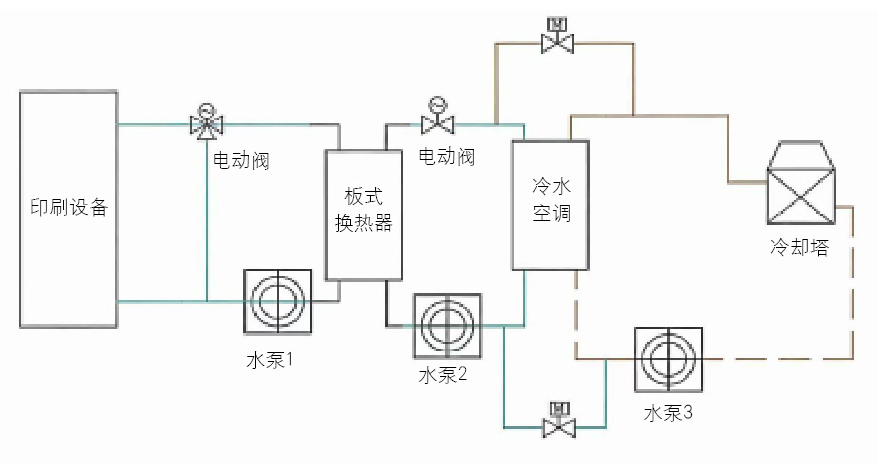 Figure 1 Renovation Roadmap
(2) Optimize and upgrade the existing air-conditioning cooling pipelines in the factory office area by adding valves to disconnect the office area from the original Carrier central air-conditioning pipelines. This allows the original central air-conditioning to continue operating independently, only serving the newspaper production workshop and other existing adapted scenarios. Then, precisely connect the office cooling pipelines to the central air-conditioning chilled water pipelines of the existing factory printing cooling system. This way, the excess cooling capacity of the printing cooling system can directly provide cooling for the office area without extra energy consumption for generating cold, significantly reducing the operating hours of the Carrier centrifugal central air-conditioning, effectively lowering equipment energy consumption, enabling efficient energy recycling, and achieving notable energy-saving goals.
02/ Add External Manual Circuit
When the system has a fault or undergoes maintenance, operators can manually control the valves and pumps to ensure production is not affected, improving system reliability.
03/ Improve Sensing and Monitoring Network
Install temperature and pressure sensors at the four key points of chilled water supply, chilled water return, cooling water supply, and cooling water return to collect full-process data from the cooling system. This provides comprehensive and accurate data support for precise PLC control, ensuring temperature control and energy-saving goals are met.
Software Optimization: Building the Intelligent Control Core Program
For this renovation, the software design uses a mainstream device control software development platform that integrates functions and is easy to operate. The platform must support multiple programming languages to simplify programming and debugging, effectively shortening the project cycle and providing technical support for stable system operation. The design uses Siemens TIA Portal V17, considering compatibility with PLC hardware and touchscreens, prioritizing products from the same brand.
The intelligent control program design focuses on three main modules: data conversion, dual-mode control, and alarms. The data conversion module uses NORM_X normalization commands and SCALE_X scaling commands to accurately convert the sensor-collected 4–20mA analog signals into temperature and pressure values recognizable by the control unit. Each Siemens analog channel has a 16-bit data width, with an operating range adjusted to -27648 to 27648, corresponding to input/output voltages of ±10V. The range 5533–27648 corresponds to input/output currents of 4–20mA. Standardized computation OUT = (VALUE–MIN)/(MAX–MIN) generates floating-point data from 0.0 to 1.0, which is further scaled with OUT = [VALUE × (MAX–MIN)] + MIN to match actual physical quantities, ensuring data conversion accuracy.
Dual-mode control is the core innovation of this software design, allowing automatic switching of operating modes based on outdoor temperature to maximize energy use (see Figure 2). In normal mode, when the outdoor temperature is high (over 12°C), the system starts the central air-conditioning. Using a PID control algorithm, it adjusts valve positions and inverter frequencies in real time to precisely control chilled water flow and pump speed, maintaining a constant pressure and temperature. The PID algorithm optimizes parameters by comparing set temperatures and pressure differences with actual values, keeping valve positions and pump speeds at optimal levels. This ensures efficient cooling while preventing energy waste.
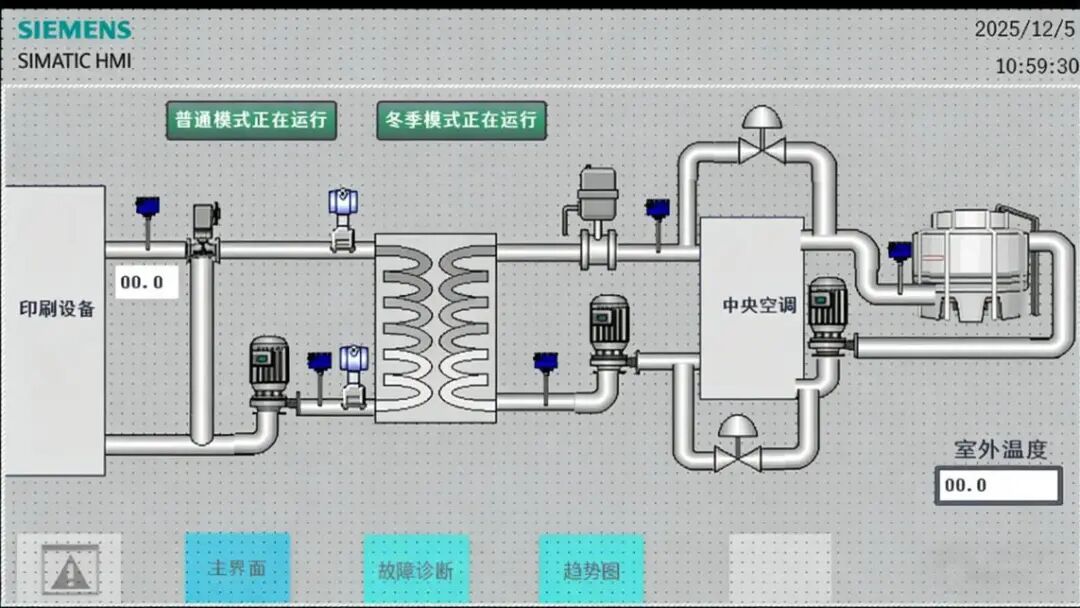 Figure 2 Dual-Mode Control Interface
In winter mode, when the outdoor temperature is low (≤12℃), the system automatically shuts down the main air conditioning unit, opens the cooling tower and central air conditioning pipeline valves, and directly uses the cooling tower water for cooling. At this time, the PID control algorithm adjusts the fan speed and the heater's on/off status, preventing the water from getting too cold and freezing, which would affect system circulation, while also minimizing energy consumption to achieve efficient operation of the winter cooling system.
The alarm program is designed with system safety and reliability in mind. By setting thresholds for key parameters such as temperature and pressure, the system immediately triggers an alarm and clearly displays it on the HMI interface if any data goes beyond normal ranges or equipment malfunctions occur. This information is also sent back to the PLC input module so operators can quickly identify and address issues. The HMI interface (Figure 3) includes multiple functional screens that can switch with one click, showing real-time system operating modes, temperatures and pressures in various pipelines, valve openings, and other key info. It also supports temperature settings and alarm confirmations, allowing operators to have a clear and comprehensive view of the system's status, significantly reducing operational difficulty and risk of mistakes, while improving overall production efficiency.
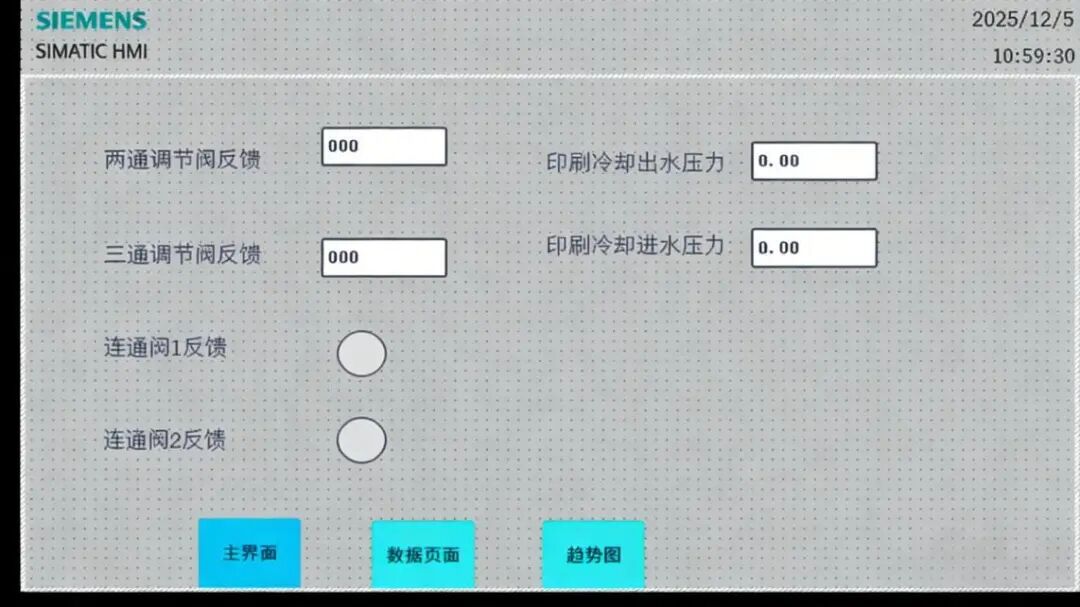 Figure 3 HMI Interaction Interface
Energy Consumption Accounting Highlights the Effectiveness of Energy-Saving and Emission-Reduction Modifications
Energy consumption accounting is based on the actual production conditions of the printing factory. The process water cooling system runs 24 hours a day, 365 days a year. During the winter mode, the operation period is concentrated from December to February, totaling 90 days. Industrial electricity is priced at 0.7 RMB/kWh.
The process water chiller is the core energy-saving component of this renovation. Before the upgrade, the chiller's annual electricity consumption was 1.8221 million kWh. After the upgrade, the chiller was stopped for 90 days in winter, reducing annual electricity consumption to 1.4793 million kWh, saving 342,800 kWh per year.
For the office cooling renovation, the office cooling was integrated into the printing process water cooling system through pipeline connections. The original Carrier central air conditioning system now only operates during early-morning production hours in the workshop, reducing operating time to one-third of the previous duration. This significantly improves the utilization efficiency of the air conditioning units in the printing process water cooling system, saving 16 hours of daily operation for the Carrier central AC system (one Carrier unit, two circulation pumps, and one cooling tower fan). The office AC is mainly used during four months of spring and summer (120 days in total), saving 857,000 kWh annually after the renovation.
The energy efficiency of the process water cooling system pumps has also improved significantly. Before the upgrade, three 18.5 kW circulation pumps consumed 486,200 kWh per year. After the renovation, using inverter control to reduce the average operating frequency to 40Hz, energy consumption decreased by 20%, with the annual electricity usage of the three pumps dropping to 388,900 kWh, saving 97,200 kWh per year.
Comprehensive accounting shows that the company saves 1.297 million kWh of electricity annually, with electricity cost savings of around 907,900 RMB. At the same time, post-upgrade system temperature control accuracy is ≤0.5°C, completely addressing condensation issues and significantly reducing printing equipment failure rates. Full-process automated monitoring has been achieved, reducing fault response time to under 5 minutes, balancing technical results with economic and management benefits.
Summary and Outlook: Deepening the Green and Intelligent Transformation Path in the Printing Industry
Our factory's PLC-based process water cooling system upgrade for printing equipment is an important step in implementing the "dual-carbon" strategy and promoting smart, green transformation. It's also an effective measure to save costs amid declining profitability in the newspaper printing industry. Following the principle of "renovate as needed, cost-effective," no large new equipment was added. Through PLC control and PID algorithm optimization, the full potential of the equipment was leveraged, strictly controlling renovation costs while ensuring system stability and compatibility. An overall energy-saving rate of about 30% and significant emission reduction results demonstrate the feasibility of intelligent technologies in printing energy-saving retrofits, offering a technical path and practical experience for similar enterprises.